
What to Expect from a Mini PC in 2026:
Reality vs. Marketing
Performance tiers, thermal limits, GPU options, AI claims — what your money actually buys. A deep dive beyond the benchmark sheets.
The Physics Reality of 2026
The mini PC market has matured significantly since 2023. AMD’s Ryzen AI 9 HX 370 and Ryzen AI Max+ 395 (Strix Halo) have brought genuine desktop-class computing into form factors smaller than a paperback. But the fundamental challenge hasn’t changed: physics. You cannot dissipate 100+ watts of heat from a 0.5-liter box without consequences.
A Ryzen AI 9 HX 370 in a mini PC is not the same as a Ryzen 9 desktop. The mobile chip operates under strict power limits (typically 35–65W sustained) to prevent the chassis from overheating. Desktop chips sustain 125W+ indefinitely with tower coolers. The gap narrows for burst workloads — opening apps, light compilation, browsing — but opens again during 30-minute sustained renders or marathon gaming sessions.
What has genuinely changed in 2026 is the unified memory architecture breakthrough. AMD’s Strix Halo platform allows the CPU and GPU to share the same high-speed RAM pool. A mini PC with 128GB of unified memory can allocate 96GB as GPU VRAM — more than any consumer discrete GPU. This changes the calculus for AI workloads dramatically, even if gaming and rendering thermal limits remain.
What this guide measures
Most reviews focus on 3-minute benchmarks. We focus on sustained real-world usability: what happens after 30 minutes of load, what bottleneck you’ll actually hit in your workflow, and what you’re paying for vs what you’re actually getting.
Tier 1: Under $300 — The Silent Workhorse
The Intel N150 has become the definitive entry-level mini PC chip of 2026 — an upgrade over the N100 that dominated 2023–2024. With 4 cores, a 3.6GHz boost clock and just 6W TDP, these machines run cool, quiet, and genuinely handle everyday productivity tasks without frustration.
The “Daily Driver” — What You Can Realistically Expect
$150–$299Honest assessment: These machines are excellent for 4K media consumption, digital signage, home office (email, Office, Zoom), and lightweight servers. The N150’s Intel UHD Graphics handles hardware-accelerated 4K video decode cleanly. They run near-silent under typical load.
- 4K@60Hz video streaming and local playback — flawless with hardware decode.
- Web browsing, Microsoft Office, Zoom — completely smooth.
- Home server, Pi-hole, Home Assistant, basic NAS duties.
- Near-silent or fully silent (fanless models available).
- Limit: 30+ browser tabs simultaneously will cause noticeable slowdown.
- Limit: Gaming limited to 2D indie titles and retro emulation (PS2/GameCube max at native resolution).
- Limit: Video editing, AI inference, compilation — all too slow for productive use.
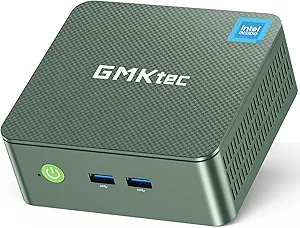
2026 update: The N150 replaces the N100 as the standard at this tier — better single-core speed, lower power draw. If you see an N100 model at a discount, it’s still a solid buy. Avoid anything older than Alder Lake-N architecture. Always buy 16GB RAM minimum — 8GB is technically functional but the integrated GPU’s shared memory leaves too little headroom for comfortable multitasking.
For a dedicated deep dive on this tier: Best Mini PCs Under $200 in 2026 and Beelink EQ14 Review.
Tier 2: $400–$700 — The Real Sweet Spot
This is where mini PCs genuinely earn the “desktop replacement” label for most users. AMD’s Ryzen 7 8745HS (Hawk Point) delivers 8 cores with Zen 5 architecture, boost clocks above 5GHz, and the Radeon 780M iGPU — capable of 1080p gaming in modern titles. This tier handles 90% of real-world workloads without compromise.
The “Versatile Workhorse” — Where Most People Should Shop
$400–$700Honest assessment: Rapid, lag-free responsiveness across all typical workflows. 1080p video editing in DaVinci Resolve works. Heavy code compilation is practical. Gaming at 1080p medium settings in modern titles like Cyberpunk 2077 is achievable — not ideal, but real. The Radeon 780M is a significant step up from the N150’s iGPU.
- Smooth 1080p video editing — DaVinci Resolve, Premiere timeline scrubbing.
- Software development: Docker, compilation, multiple IDEs simultaneously.
- 1080p gaming at medium–high settings (esports titles at 60-100fps, older AAA at 40-60fps).
- 32GB RAM standard — handles PS3 emulation, RPCS3, Switch/Ryujinx.
- Dual 2.5GbE + OCuLink for future eGPU expansion.
- Limit: 4K video export will be noticeably slower than a desktop with a dedicated GPU.
- Limit: Fans are audible under sustained gaming or rendering load.
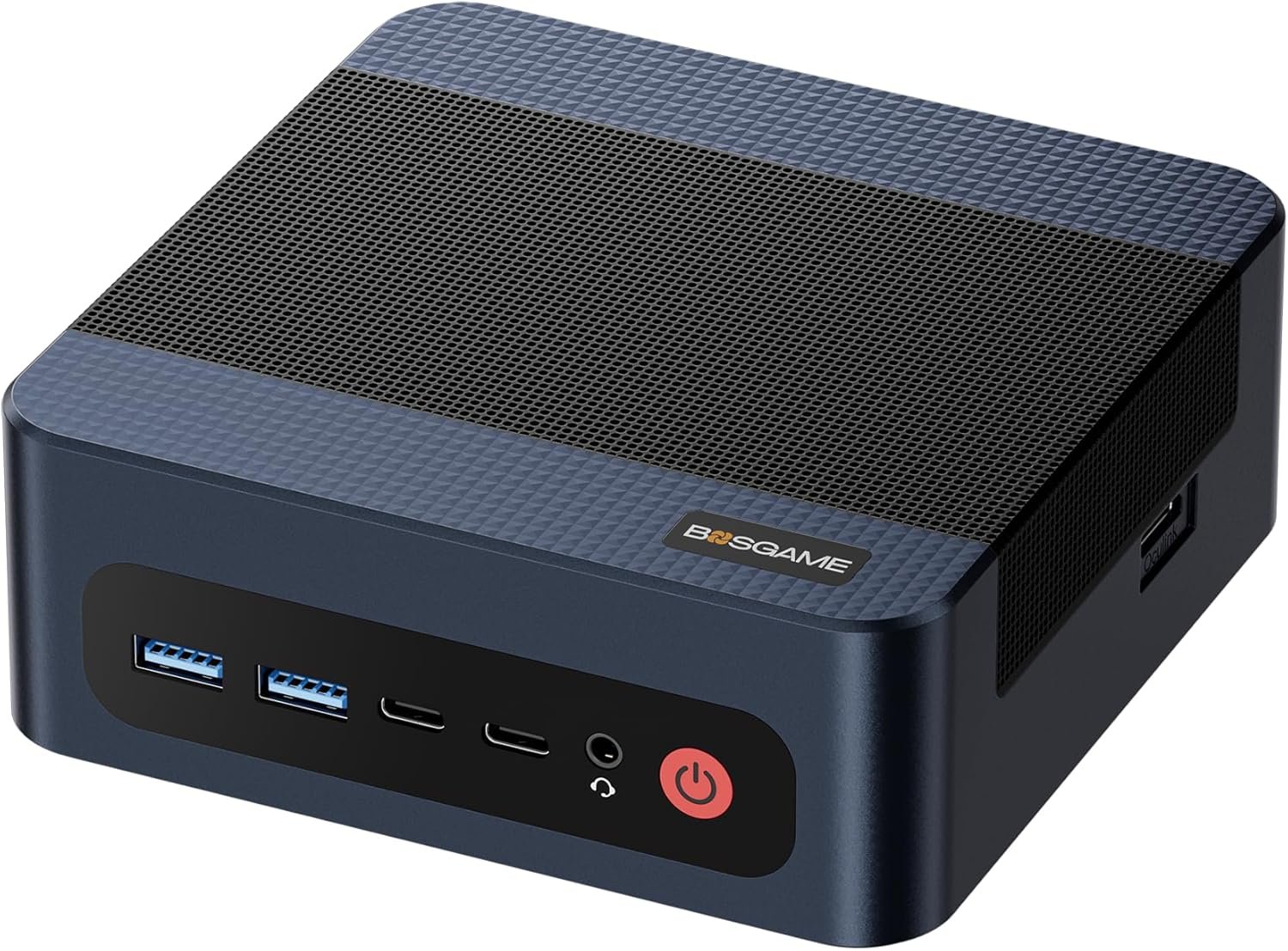
The standout value at this tier in 2026 is the BOSGAME M4 (~$489): Ryzen 7 8745HS, 32GB, dual 2.5GbE, OCuLink port. The OCuLink port is the most important long-term feature — it allows adding an RTX 4060 or 4070 eGPU later without any PCIe bandwidth penalty, effectively future-proofing your setup. Full review: BOSGAME M4 Review.
Tier 3: $800+ — The Power Bricks
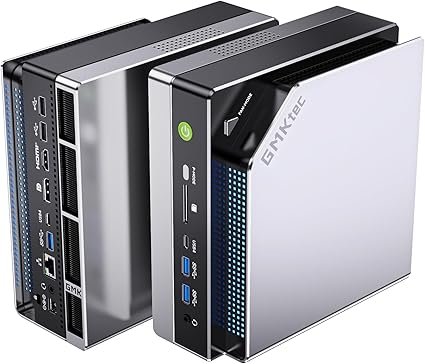
This tier is defined by AMD’s Ryzen AI 9 HX 370 (Strix Point) and Ryzen AI Max+ 395 (Strix Halo). These are engineering achievements — the former brings 12 Zen 5 cores with 50 TOPS NPU into a 28W TDP envelope; the latter uses unified memory architecture to enable 96GB of GPU VRAM in a 0.6-liter box. But thermal physics still applies.
The “Power Brick” — Maximum Density, Real Tradeoffs
$800–$2,000Honest assessment: The Ryzen AI 9 HX 370 (Peladn HO5, ~$940) handles Mistral 7B at 35 tokens/second and Qwen3 32B at 10 tokens/second locally. The Strix Halo EVO-X2 at 128GB runs Llama 3 70B and Qwen3 235B — the only mini PC that can. Gaming at 1080p is solid; 1440p is possible on the EVO-X2.
- HX 370 (Peladn HO5): 30–40 t/s Mistral 7B, 8–12 t/s Qwen3 32B locally.
- Strix Halo (EVO-X2 128GB): Runs Llama 3 70B at 18–25 t/s, Qwen3 235B at ~11 t/s.
- Radeon 890M / 8060S iGPU: genuine 1080p gaming, Cyberpunk at 55+ fps.
- 50 TOPS NPU for Windows Copilot+ features, on-device AI tasks.
- Limit: Thermal throttling under sustained 30-min+ heavy load — performance drops 15–25% from peak.
- Limit: Fan noise reaches 40–50dB under maximum load — not silent.
The GPU Dilemma & The OCuLink Reality
The inherent limitation of any mini PC remains its integrated GPU. The iGPU shares system RAM bandwidth with the CPU — there’s no dedicated GDDR6X VRAM, no independent memory bus. However, two developments have significantly improved the graphics situation in 2026.
First, unified memory architecture in Strix Halo allows the GPU to access all 128GB of system RAM at 256 GB/s — enough bandwidth to run 70B+ parameter LLMs entirely in GPU memory, which is impossible even on an RTX 4090 (limited to 24GB GDDR6X). For AI workloads specifically, unified memory changes everything.
Second, OCuLink has become the definitive external GPU standard for mini PCs. Unlike USB4/Thunderbolt, which loses 15–20% of discrete GPU performance through encoding overhead, OCuLink provides a near-native PCIe 4.0 connection — virtually zero performance penalty. The BOSGAME M4 and Peladn HO5 both include OCuLink ports, allowing you to dock a full RTX 4070 or 4080 when at your desk.
For a detailed explanation of how OCuLink works and which mini PCs support it: What Is OCuLink? Complete eGPU Guide.
The AI Hype: NPU Reality in 2026
Every manufacturer markets their product as an “AI PC” in 2026. Here is what the NPU marketing actually means — and what it doesn’t.
| Component | What it actually does well | What it can’t do |
|---|---|---|
| NPU (50 TOPS) Ryzen AI 9 HX 370, Strix Halo | Background tasks: video call noise cancellation, live captions, Windows Copilot features, real-time translation, Windows Hello. Very efficient at sustained low-power inference. | Running large language models (7B+), image generation, complex AI workflows. Too slow and too little dedicated memory for heavy AI generation tasks. |
| iGPU (Radeon 890M / 8060S) Unified memory architecture | Running local LLMs (7B–32B for HX 370, up to 235B for Strix Halo 128GB). Stable Diffusion image generation at 1–5 images/min. Vulkan-based inference via llama.cpp. | Sustained heavy gaming at 4K, training large models, real-time video generation at high quality. |
| External GPU via OCuLink RTX 4060/4070/4080 | High-frame-rate gaming, fast image generation (Stable Diffusion XL at 10+ img/min on RTX 4070), running large AI models on dedicated VRAM. | Portability — eGPU setups require a dock, cables, and a power supply. Not mobile. |
The practical takeaway: the NPU handles lightweight background AI tasks efficiently and extends battery life on laptops. For serious local AI work — running Llama 3, Qwen3, Mistral, or generating images with Stable Diffusion — the iGPU or an external GPU matters far more than the NPU TOPS number.
Local AI in 2026: What’s Actually Possible
This is new territory since our 2025 edition. The open-source AI landscape has changed dramatically: Qwen3 235B, Llama 3.1 70B, and Mistral 7B now rival GPT-4 class performance on many benchmarks. Running these models locally means zero subscription cost, complete privacy, and no internet required. Here’s what each tier can actually do:
Local AI performance by mini PC tier
N150 tier (EQ14, G3 Plus): Cannot run LLMs meaningfully — insufficient RAM and iGPU.
Ryzen 7 tier (BOSGAME M4, 32GB): Mistral 7B at 15–20 t/s, Qwen3 14B at 8–12 t/s — usable for interactive chat.
Ryzen AI 9 HX 370 (Peladn HO5, 32GB): Mistral 7B at 30–40 t/s, Qwen3 32B at 8–12 t/s — genuinely interactive.
Strix Halo 128GB (EVO-X2): Llama 3.1 70B at 18–25 t/s, Qwen3 235B at ~11 t/s — the only mini PC that runs frontier-class models locally.
For a complete guide to running AI models locally on a mini PC — including software recommendations (LM Studio, Ollama, llama.cpp) and model selection: Best Mini PC for Local AI 2026.
Best Picks of 2026 — Updated
Based on current market prices and real-world performance, these are our recommended mini PCs for each major use case in April 2026.
| Use case | Model | Key specs | Price | Link |
|---|---|---|---|---|
| BUDGET Office · Streaming · Server | Beelink EQ14 | N150 · 16GB · Dual 2.5GbE | ~$200 | Check Price |
| SWEET SPOT Gaming · Dev · Emulation | BOSGAME M4 | Ryzen 7 8745HS · 32GB · OCuLink · Dual 2.5G | ~$489 | Check Price |
| POWER Local AI · Home office | Peladn HO5 | Ryzen AI 9 HX 370 · 32GB · OCuLink · Wi-Fi 7 | ~$940 | Check Price |
| ULTIMATE AI 70B+ LLMs · Qwen3 235B | GMKtec EVO-X2 128GB | Ryzen AI Max+ 395 · 128GB · 96GB VRAM · 256 GB/s | ~$1,999 | Check Price |
Further reading
Best Mini PC for Local AI 2026 · Best Mini PC for Gaming 2026 · Best Mini PC for Home Server 2026 · Mini PC vs Desktop 2026 · Mini PC vs Laptop 2026
Prices reflect Amazon US listings as of April 2026 and may change. As an Amazon Associate, we earn from qualifying purchases.