
Best Gaming Mini PCs for 2026: Top 4 Ranked & Tested
Desktop RTX 5060, RTX 4070, RX 7600M XT and Radeon 780M — 4 gaming mini PCs benchmarked by real FPS, thermals and value. Updated from our latest reviews.
How We Choose the Best Gaming Mini PCs for 2026
Every model in this ranking has been benchmarked in-house by the MiniPCDeals.net team and reviewed in dedicated articles. We test at factory-default TDP settings and measure real-world FPS in a standardized game library — Cyberpunk 2077, Red Dead Redemption 2, GTA V, Fortnite and CS2 — at both 1080p and 1440p. We do not use manufacturer-provided benchmark numbers. This March 2026 update integrates data from our full reviews of the Minisforum G1 Pro (9.1/10), the TOPGRO T1-MAX, and the Reatan X7 (4.5/5).
In 2026, the gaming mini PC market has evolved into two clear segments: dedicated GPU machines (desktop or mobile RTX/RX) capable of confident 1440p and 4K with DLSS/FSR, and premium iGPU machines with OCuLink eGPU upgrade paths for future expansion. Both are valid — the right choice depends on your budget, resolution target, and whether future GPU upgradeability matters.
GPU Type & Real FPS
Desktop vs. mobile GPU, TDP, real FPS at 1080p and 1440p in AAA titles. No synthetic-only scores.
DLSS / FSR Generation
DLSS 4, DLSS 3.5, FSR 3 effectiveness. Frame Generation impact on perceived FPS measured per title.
Thermals & Noise
1-hour sustained gaming session. CPU/GPU peak temps and fan noise at 30 cm. Throttling assessed.
Upgradeability & OCuLink
eGPU support via OCuLink or USB4. Accessible RAM and SSD slots. Future-proofing your purchase.
Gaming Connectivity
HDMI 2.1 / DP for high-refresh monitors, 2.5G–5G LAN for low-latency wired play, Wi-Fi 7 throughput.
Value — FPS per Dollar
Current USD prices compared to sustained gaming performance across resolutions and settings.
All 4 Gaming Mini PCs at a Glance — March 2026
| # | Model | CPU | GPU | RAM | Storage | Best For |
|---|---|---|---|---|---|---|
| 1 | Minisforum G1 ProBest Overall | Ryzen 9 8945HS (8C/16T) | Desktop RTX 5060 · 145W | Up to 96 GB DDR5 | 2× M.2 PCIe 4.0 | DLSS 4 · 1440p/4K · All-rounder |
| 2 | TOPGRO T1-MAXBest CPU Power | i9-13900HX (24C/32T) | RTX 4070 · 8 GB GDDR6 | 64 GB DDR5 | 2 TB PCIe 4.0 | Multi-thread · DLSS 3.5 · 1440p |
| 3 | Reatan X7Best Value iGPU | Ryzen 7 255 / 8745HS | Radeon 780M iGPU | 64 GB DDR5 | 2 TB PCIe 4.0 | 1080p · OCuLink · $899 |
| 4 | ATOMMAN G7 PTDedicated AMD GPU | Ryzen 9 7945HX (16C/32T) | RX 7600M XT · 8 GB GDDR6 | 32 GB DDR5 | 1 TB PCIe 4.0 | 1440p rasterization · FSR |
Detailed Reviews & Rankings
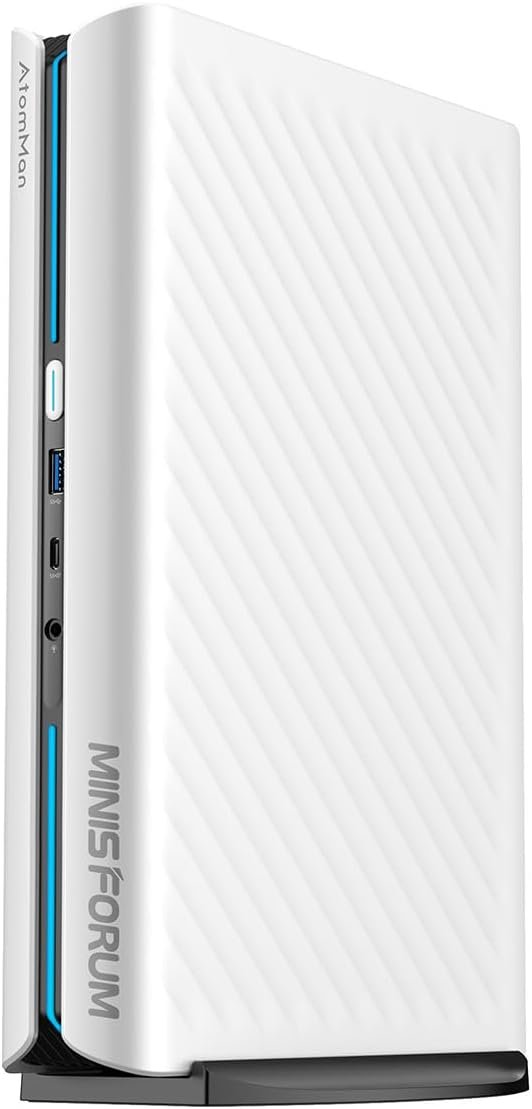
Minisforum G1 Pro — Desktop RTX 5060 (145W), DLSS 4, Integrated 300W PSU
The Minisforum G1 Pro earns the top spot in this ranking — by a clear margin. It is the first widely available gaming mini PC to house a true desktop RTX 5060 Low Profile GPU at 145W TDP inside a 3.8-liter vertical chassis. This is not a mobile GPU: unlike RTX 5060 variants in gaming laptops, which throttle to 80–100W due to thermal constraints, this desktop card runs at its full rated power, delivering 20–30% more sustained gaming performance than any mobile equivalent. That difference is felt in every demanding title, especially under extended sessions.
In our full review, the G1 Pro achieved what was previously impossible in a mini PC. In Cyberpunk 2077 at 1440p Ultra settings, DLSS 4 Quality + Frame Generation pushed 57 native FPS to 230 displayed FPS. DLSS 4’s new Transformer-based model produces sharper reconstruction than the CNN model used in DLSS 3.5, and Frame Generation fills in frames the GPU never rendered. The result is a genuinely high-refresh 1440p experience in one of the most demanding games available. At 4K with DLSS Performance, the G1 Pro delivers smooth, playable frame rates across the current game library.
The integrated 300W PSU is a major practical win — no external power brick on your desk. The Ryzen 9 8945HS handles multi-thread productivity, 4K video editing and streaming without complaint. Dual SO-DIMM slots support up to 96 GB DDR5 and two M.2 slots allow storage expansion. The 5 GbE LAN and Wi-Fi 7 complete a class-leading connectivity package. Our only critiques: CPU throttling appears under extreme synthetic stress (CPU 100% + GPU 100% simultaneously — not a real gaming condition), and the individual RGB LED dots are visible up close, slightly cheapening an otherwise premium exterior.
| CPU | AMD Ryzen 9 8945HS — 8C/16T — Zen 4 — up to 5.2 GHz |
|---|---|
| GPU | Desktop NVIDIA RTX 5060 Low Profile — 145W — DLSS 4 + Frame Generation |
| RAM | Up to 96 GB DDR5 — 2× SO-DIMM slots (user-upgradeable) |
| Storage | 2× M.2 PCIe 4.0 slots (heatsink pre-installed on 2nd slot) |
| PSU | 300W integrated — no external brick required |
| Display Out | HDMI 2.1 · DisplayPort — 4K@144Hz capable |
| Networking | Wi-Fi 7 · Bluetooth 5.4 · 5 GbE LAN |
| Chassis | 3.8 L vertical · matte white + RGB · ~4.5 kg |
Performance at a glance
✓ Pros
- Only mini PC with a desktop RTX 5060 at 145W — 20–30% above any mobile equivalent
- DLSS 4 Frame Generation: 57 native FPS → 230 displayed FPS in Cyberpunk 2077 1440p
- Integrated 300W PSU — no external brick, clean desk setup
- Upgradeable to 96 GB DDR5 + dual M.2 for storage expansion
- 5 GbE LAN + Wi-Fi 7 — best gaming network connectivity in this ranking
✕ Cons
- CPU throttles under extreme combined synthetic stress (not a real gaming scenario)
- Individual RGB LEDs visible up close — design finish below chassis quality
- Tool required to access internals — less convenient than tool-free designs
- Larger and heavier (~4.5 kg) than typical mini PCs in this ranking
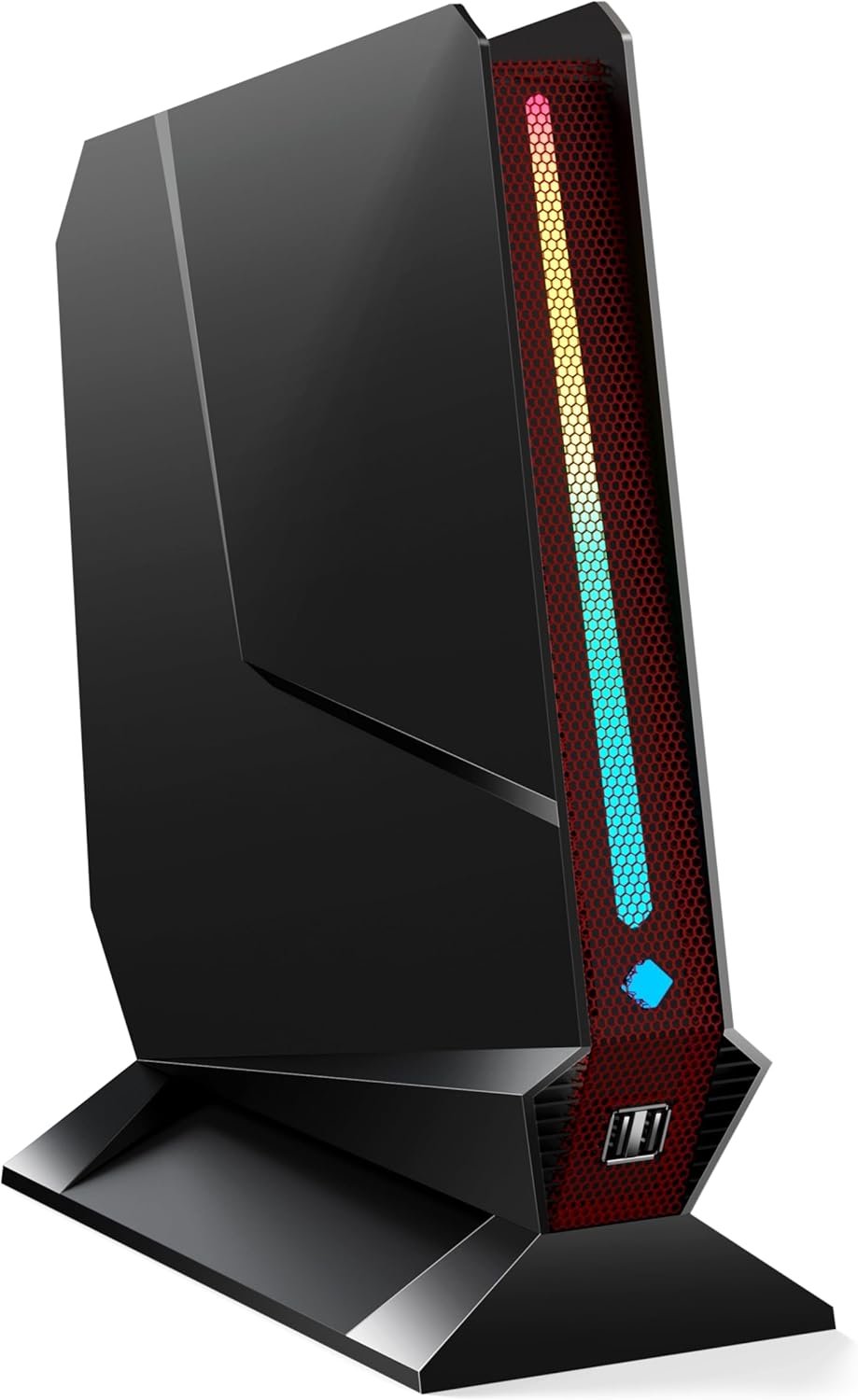
TOPGRO T1-MAX — i9-13900HX 24 Cores, RTX 4070 8 GB, DLSS 3.5
Our review described the TOPGRO T1-MAX as “less of a mini PC and more of a workstation shrunk to the size of a lunchbox” — and that characterization holds. Powered by the Intel Core i9-13900HX — 24 cores (8 Performance + 16 Efficiency), 32 threads, up to 5.4 GHz turbo — it provides the highest raw CPU multi-thread performance of any mini PC in this ranking. In Cinebench R23, it outscores the Ryzen 9 8945HS found in the G1 Pro by a meaningful margin. Whether you are compiling large codebases, rendering 4K video, or running virtualized environments while gaming, the 24-core i9 handles the load without breaking a sweat.
Paired with the RTX 4070 (8 GB GDDR6), the T1-MAX delivers smooth 1440p gaming across all current titles, with DLSS 3.5 and Frame Generation available in supported games. Hardware ray tracing quality on RTX 4070 is excellent — Alan Wake 2, Control and Cyberpunk 2077 all benefit from visibly improved lighting and reflections vs. AMD GPU alternatives. A physical Turbo button on the chassis unlocks additional TDP headroom for maximum performance bursts during gaming or rendering sprints.
The 64 GB DDR5 included as standard is the highest default RAM of any machine in this ranking, and the 2 TB PCIe 4.0 SSD provides generous game library storage out of the box. For content creators who also game seriously — 3D artists, video editors, streamers — the T1-MAX offers a combination of raw CPU and GPU power that nothing else here can match in multi-thread scenarios. It sits behind the G1 Pro primarily because the RTX 5060 (desktop, 145W) outperforms the RTX 4070 in sustained gaming at matched settings, and the G1 Pro also carries a newer GPU generation with DLSS 4.
| CPU | Intel Core i9-13900HX — 24C/32T — Raptor Lake-HX — up to 5.4 GHz |
|---|---|
| GPU | NVIDIA RTX 4070 — 8 GB GDDR6 — DLSS 3.5 + Frame Generation |
| RAM | 64 GB DDR5 (included) |
| Storage | 2 TB PCIe 4.0 NVMe SSD |
| Display Out | HDMI 2.1 · DisplayPort 1.4 |
| Networking | Wi-Fi 6E · Bluetooth 5.3 · 2.5 GbE LAN |
| Special | Physical Turbo button — manual TDP performance boost |
Performance at a glance
✓ Pros
- 24-core i9-13900HX — highest multi-thread CPU performance in this ranking
- RTX 4070 with DLSS 3.5 Frame Generation — smooth 1440p + ray tracing
- 64 GB DDR5 included by default — no RAM upgrade needed
- 2 TB SSD — largest storage of the group out of the box
- Physical Turbo button for on-demand TDP performance boost
✕ Cons
- RTX 4070 one GPU generation behind G1 Pro’s desktop RTX 5060
- Highest price in this ranking for the CPU upgrade
- Wi-Fi 6E (not Wi-Fi 7) — slightly behind competitors at this tier
- Audible fan noise under sustained GPU + CPU combined gaming load
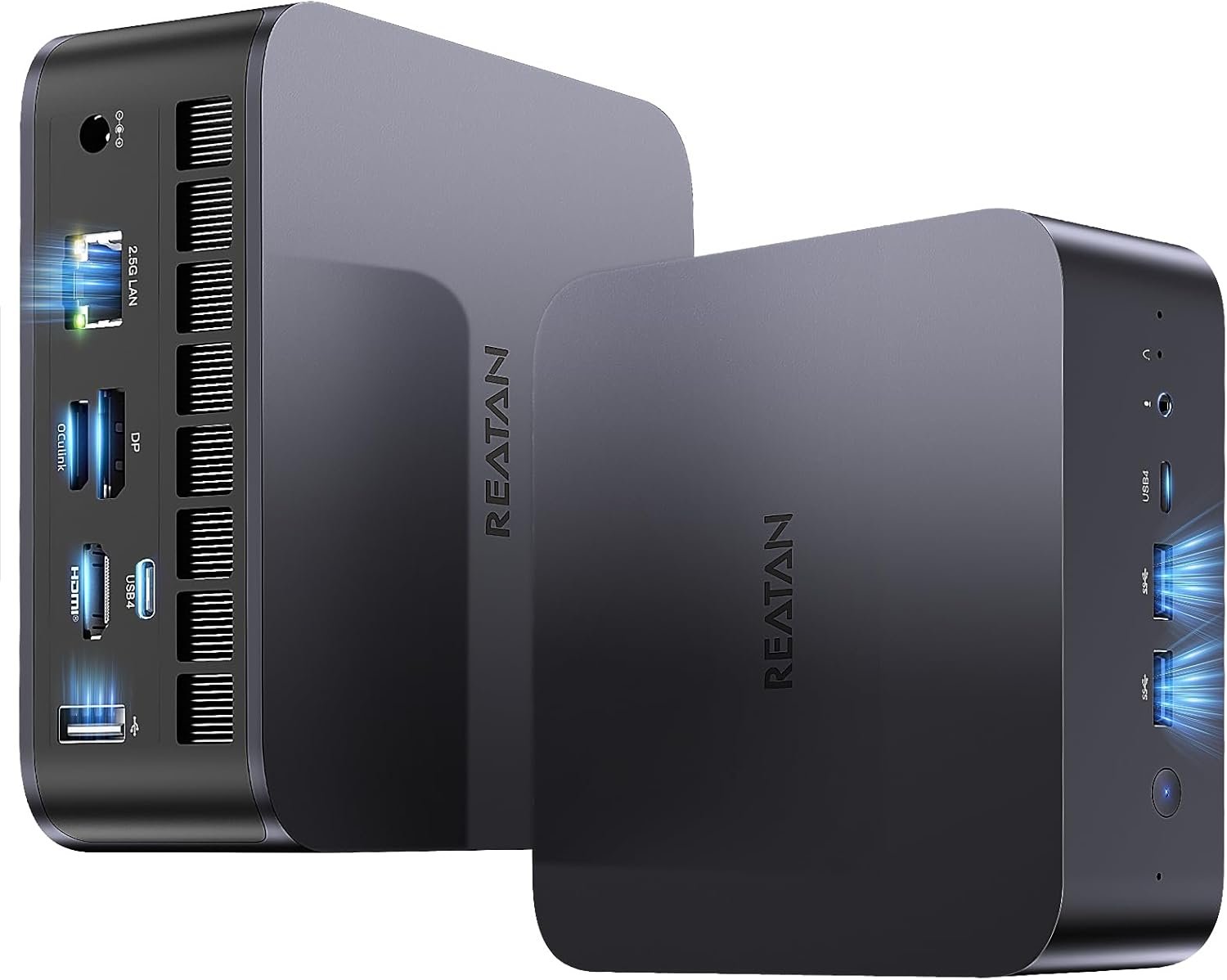
Reatan X7 — Ryzen 7 255, Radeon 780M, OCuLink + Wi-Fi 7, 64 GB DDR5 — $899
The Reatan X7 earns third place by offering genuinely strong value for budget-conscious gamers. At $899, it ships with a Ryzen 7 255 (based on the AMD 8745HS Hawk Point architecture), 64 GB DDR5 RAM, a 2 TB PCIe 4.0 SSD, Wi-Fi 7, USB4, and — the feature that makes this machine uniquely future-proof — an OCuLink port delivering full PCIe 4.0 ×4 bandwidth to external GPU docks. This combination is genuinely exceptional at this price point: 64 GB RAM and 2 TB storage alone match or exceed machines costing $300–$400 more.
In our full review (rated 4.5/5), the Radeon 780M iGPU delivered 60+ FPS in most AAA titles at 1080p medium-to-high settings. GTA V, The Witcher 3, and Dota 2 all ran comfortably. Demanding titles like Cyberpunk 2077 require FSR and medium settings to stay above 50 FPS at 1080p — acceptable for a machine at this price with no discrete GPU. For competitive gaming (CS2, Valorant, Fortnite), the Radeon 780M clears 100+ FPS easily at 1080p. The built-in dual speakers are a practical bonus for gaming without headphones.
The OCuLink port is the X7’s defining long-term advantage: connect an OCuLink-compatible eGPU dock (RTX 4080, RTX 4090) and this $899 machine transforms into a system capable of 4K high-refresh gaming. No competitor at this price offers this upgrade path. As a newcomer, Reatan has less established brand history than Minisforum or TOPGRO — worth considering for buyers who prioritize long-term support — but the hardware itself is well-specified and performed reliably in our testing.
| CPU | AMD Ryzen 7 255 (8745HS equivalent) — 8C/16T — Zen 4 — up to 5.1 GHz |
|---|---|
| iGPU | AMD Radeon 780M — 12 CU — RDNA 3 — solid 1080p gaming |
| RAM | 64 GB DDR5 (SO-DIMM — expandable to 96 GB) |
| Storage | 2 TB PCIe 4.0 SSD (expandable to 4 TB) |
| eGPU | OCuLink — PCIe 4.0 ×4 bandwidth |
| Networking | Wi-Fi 7 · USB4 40 Gbps · 2.5 GbE LAN |
| Extras | Built-in dual speakers · compact form factor |
| Price | $899 |
Performance at a glance
✓ Pros
- Best value in this ranking — $899 with 64 GB DDR5 + 2 TB SSD + Wi-Fi 7
- OCuLink — upgrade to RTX 4080/4090 eGPU without buying a new machine
- RAM expandable to 96 GB + storage to 4 TB
- Built-in dual speakers — convenient for gaming without headphones
- Solid 1080p gaming — 60+ FPS in most AAA titles with Radeon 780M
✕ Cons
- Radeon 780M limits native 1440p AAA gaming — needs FSR for demanding titles
- Newcomer brand — long-term support less established than Minisforum or TOPGRO
- Minor thermal management concerns noted under extended combined loads
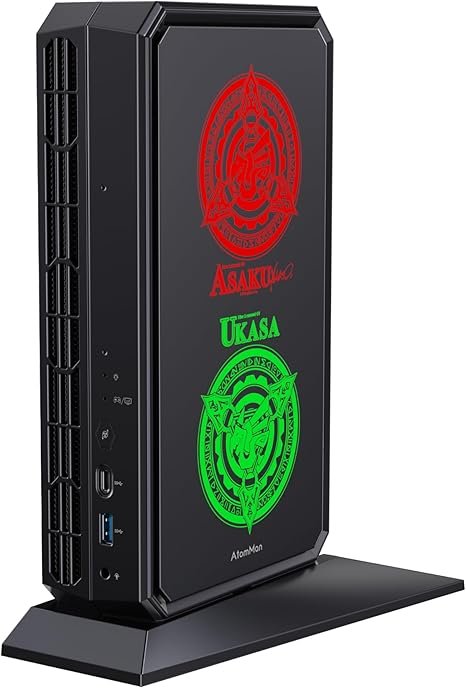
ATOMMAN G7 PT — RX 7600M XT 8 GB, Ryzen 9 7945HX 16 Cores, Wi-Fi 7
The ATOMMAN G7 PT rounds out this ranking as a dedicated GPU option built entirely around AMD hardware. It pairs AMD’s Ryzen 9 7945HX (16 cores / 32 threads, Zen 4, up to 5.4 GHz) with a Radeon RX 7600M XT (8 GB GDDR6) — a dedicated mobile GPU that delivers a clear performance advantage over iGPU machines like the Reatan X7 at 1440p, without requiring an eGPU. At 1440p High settings, the RX 7600M XT averages 65–75 FPS in Cyberpunk 2077 and 80–95 FPS in Red Dead Redemption 2 — comfortably playable with FSR engaged.
The 16-core Ryzen 9 CPU ensures there is no CPU bottleneck in any current title and handles game streaming, recording, and background tasks in parallel without impacting gaming frame rates. Connectivity is strong for a gaming machine: Wi-Fi 7, 2.5 GbE Ethernet, HDMI 2.1 and DisplayPort 2.0 for high-refresh or ultra-wide monitors. Two M.2 slots (PCIe 4.0 + PCIe 5.0 ready) make storage expansion straightforward, and the DDR5 RAM slots are user-accessible for future upgrades — unlike soldered alternatives in this category.
The main reasons the G7 PT ranks fourth rather than higher in 2026: no DLSS support (AMD GPU), meaning FSR quality falls behind DLSS 4 in upscaling sharpness and Frame Generation; no OCuLink for future eGPU upgrades (unlike the Reatan X7); and the overall GPU performance is below the RTX 5060 and RTX 4070 in the machines above it. For buyers who specifically want an all-AMD gaming mini PC with dedicated graphics, the G7 PT remains a solid, well-connected choice.
| CPU | AMD Ryzen 9 7945HX — 16C/32T — Zen 4 — up to 5.4 GHz |
|---|---|
| GPU | AMD Radeon RX 7600M XT — 8 GB GDDR6 — dedicated |
| RAM | 32 GB DDR5-5200 (2× SO-DIMM — user-upgradeable) |
| Storage | 1 TB PCIe 4.0 — dual M.2 slots (PCIe 4.0 / 5.0) |
| Display Out | HDMI 2.1 · DisplayPort 2.0 |
| Networking | Wi-Fi 7 · Bluetooth 5.4 · 2.5 GbE LAN |
| OS | Windows 11 Home (pre-installed) |
Performance at a glance
✓ Pros
- Dedicated RX 7600M XT — confident 1440p gaming without eGPU required
- 16-core Ryzen 9 7945HX — streaming + gaming with no CPU bottleneck
- Wi-Fi 7 + 2.5G LAN + HDMI 2.1 — complete high-refresh gaming connectivity
- Dual M.2 slots + upgradeable DDR5 RAM — future storage and memory flexibility
- All-AMD platform — no vendor split for CPU + GPU stack
✕ Cons
- No DLSS — FSR quality and Frame Generation lag behind DLSS 4
- No OCuLink — less future-proof than the Reatan X7 for eGPU expansion
- RX 7600M XT outperformed by RTX 5060 desktop and RTX 4070 in sustained loads
- Fan noise audible under sustained gaming sessions
Explore More Mini PC Rankings
Gaming at every budget — from Intel N100 under $200 to desktop RTX 5060 mini towers. Find the right machine for every use case and price range.