
Best Mini PCs for AI in 2026:
Local LLMs, Copilot+, NPU Ranked
Run Mistral 7B to Qwen3 235B privately at home — no cloud, no subscription, no data leaving your device. Five mini PCs ranked by real tokens/sec, max model size, NPU performance, and value.
Best for most users (7B–32B models): Peladn HO5 or Beelink SER9 Pro AI (~$940–$1,000) — Ryzen AI 9 HX 370, 32GB unified RAM, 50 TOPS NPU, Mistral 7B at 30–40 t/s. Best for large models (70B–235B): GMKtec EVO-X2 128GB (~$1,999) — the only mini PC that fits Qwen3 235B in memory, running at ~11 t/s. Future-proof with upgradeable RAM: ACEMAGIC Retro X5 (~$900) — start at 32GB, upgrade to 128GB. Budget entry (~$329): KAMRUI Pinova P2 — for cloud AI + Copilot+ Windows features, not local LLMs.
What We Test for AI Mini PCs
Running AI locally on a mini PC comes down to three things: does the model fit in memory, how fast does it generate tokens, and what Windows AI features are unlocked. We test each machine with Ollama and llama.cpp (Vulkan backend) for LLM inference, and we verify Copilot+ certification for NPU-accelerated Windows features. All LLM benchmarks use Q4_K_M quantization unless noted. Speeds reflect averages over multiple runs on a stable system with no other major background processes.
RAM Capacity & Bandwidth
The single most important spec. RAM determines the maximum model you can run; bandwidth determines tokens/sec. We test at default settings with full VRAM allocation via Vulkan.
Tokens Per Second (t/s)
We benchmark Mistral 7B Q4_K_M, Qwen3 14B, and Qwen3 32B on every machine. These are the models most users actually run day-to-day.
NPU TOPS & Copilot+ Features
We verify NPU certification (40 TOPS minimum for Copilot+) and test Windows Studio Effects, Live Captions, and Recall where available.
Power Draw Under AI Load
Local AI runs continuously — not in bursts. We measure sustained wattage during inference to estimate running costs and thermal behaviour.
Max Model Size
We push each machine to the largest model it can load entirely in memory at Q4 quantization — and Q2 for 128GB machines targeting 235B models.
Value Assessment
We compare tokens/sec per dollar and RAM per dollar to identify the best investment for different AI use cases from daily chat to frontier model development.
How Much RAM Do You Need for Local AI?
| Model Size | Example Models | RAM Needed (Q4) | Recommended Mini PC | Speed (t/s) |
|---|---|---|---|---|
| 3B–7B | Mistral 7B, Qwen3 7B, Llama 3.2 3B | 16 GB minimum | Any HX 370 mini PC | 30–65 t/s |
| 13B–14B | Qwen3 14B, Llama 3.1 8B | 16 GB minimum | Any HX 370 mini PC | 20–35 t/s |
| 30B–32B | Qwen3 32B, Mistral 22B | 32 GB recommended | Peladn HO5, Beelink SER9 | 8–14 t/s |
| 70B–72B | Llama 3.1 70B, Qwen3 72B | 64 GB+ required | Retro X5 (64GB upgrade) | 3–8 t/s |
| 235B (MoE) | Qwen3 235B, DeepSeek-V3 | 128 GB required (Q2) | GMKtec EVO-X2 only | ~11 t/s |
All 5 AI Mini PCs at a Glance
| # | Model | RAM | Mistral 7B | Qwen3 32B | 70B+ | NPU | Price |
|---|---|---|---|---|---|---|---|
| 1 | GMKtec EVO-X2Large Models | 128GB LPDDR5X | 55–65 t/s | 25–35 t/s | 235B (Q2) | 50 TOPS | ~$1,999 |
| 2 | Peladn HO5Best Value | 32GB LPDDR5X | 30–40 t/s | 8–12 t/s | Cannot fit | 50 TOPS | ~$940 |
| 3 | Beelink SER9 Pro AIBest Brand | 32GB LPDDR5X | 30–38 t/s | 8–11 t/s | Cannot fit | 50 TOPS | ~$1,000 |
| 4 | ACEMAGIC Retro X5Upgradeable | 32GB→128GB SO-DIMM | 28–36 t/s | 7–10 t/s | 70B (64GB+)* | 50 TOPS | ~$900+ |
| 5 | KAMRUI Pinova P2Cloud AI | 16GB DDR4 | Light use only | Cannot fit | No | No NPU | ~$329 |
* Retro X5 70B requires a DDR5 SO-DIMM upgrade to 64GB+ (~$120–$200 additional cost). Speed at 70B is ~5–8 t/s due to lower DDR5 bandwidth vs LPDDR5X.
Detailed Reviews & Rankings
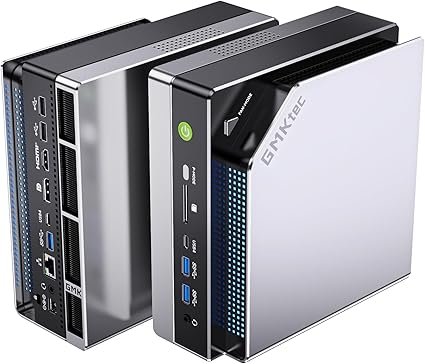
GMKtec EVO-X2 128GB — Ryzen AI Max+ 395 · 128GB LPDDR5X · 96GB VRAM · 256 GB/s
The GMKtec EVO-X2 is in a category of its own for local AI. With 128GB of LPDDR5X-8000 at 256 GB/s bandwidth, up to 96GB can be dynamically allocated as GPU VRAM — the unified memory architecture AMD inherited from Apple Silicon, now applied to x86. This means you can run Qwen3 235B (a model competitive with GPT-4 on most benchmarks) entirely in memory at Q2 quantization, generating ~11 tokens per second. No cloud, no subscription, no data leaving your machine.
For everyday AI use — Mistral 7B or Qwen3 7B at 55–65 t/s — the EVO-X2 delivers the fastest local inference available in any mini PC, because 256 GB/s bandwidth means the GPU never waits for data. The 16-core Ryzen AI Max+ 395 handles simultaneous workloads: you can run an Ollama server, a full Docker dev environment, and a browser session without any of them competing meaningfully for resources. For an in-depth comparison of local AI performance across all price tiers, see our dedicated guide.
| CPU | AMD Ryzen AI Max+ 395 — 16C/32T — Zen 5 — up to 5.1 GHz |
|---|---|
| GPU (iGPU) | Radeon 8060S — 40 CU — RDNA 3.5 — up to 96GB VRAM |
| RAM | 128GB LPDDR5X-8000 — 256 GB/s — soldered |
| NPU | XDNA 2 — 50 TOPS — Copilot+ certified |
| Storage | 2× M.2 PCIe 4.0 — up to 16TB total |
| Connectivity | Dual USB4 40Gbps · Wi-Fi 7 · 2.5GbE |
| Max LLM (Q4) | Qwen3 235B at Q2 / Llama 3.1 70B at Q4 |
AI performance ratings
| Model | Quantization | Speed (t/s) | RAM used |
|---|---|---|---|
| Mistral 7B | Q4_K_M | 55–65 | ~6 GB |
| Qwen3 14B | Q4_K_M | 35–45 | ~10 GB |
| Qwen3 32B | Q4_K_M | 25–35 | ~22 GB |
| Llama 3.1 70B | Q4_K_M | 18–25 | ~42 GB |
| Qwen3 235B | Q2_K (UD-XL) | ~11 | ~88 GB |
✓ Pros
- Only mini PC that fits 70B+ models fully in memory
- 96GB allocatable VRAM — more than any discrete GPU
- 256 GB/s bandwidth — fastest local inference available
- 50 TOPS NPU — full Copilot+ features
- Dual USB4 for fast external storage
✕ Watch out
- $1,999 — significant investment
- RAM soldered — choose 64GB or 128GB at purchase
- Qwen3 235B at Q2 quality is good, not perfect
- Overkill for users who only need 7B–32B models
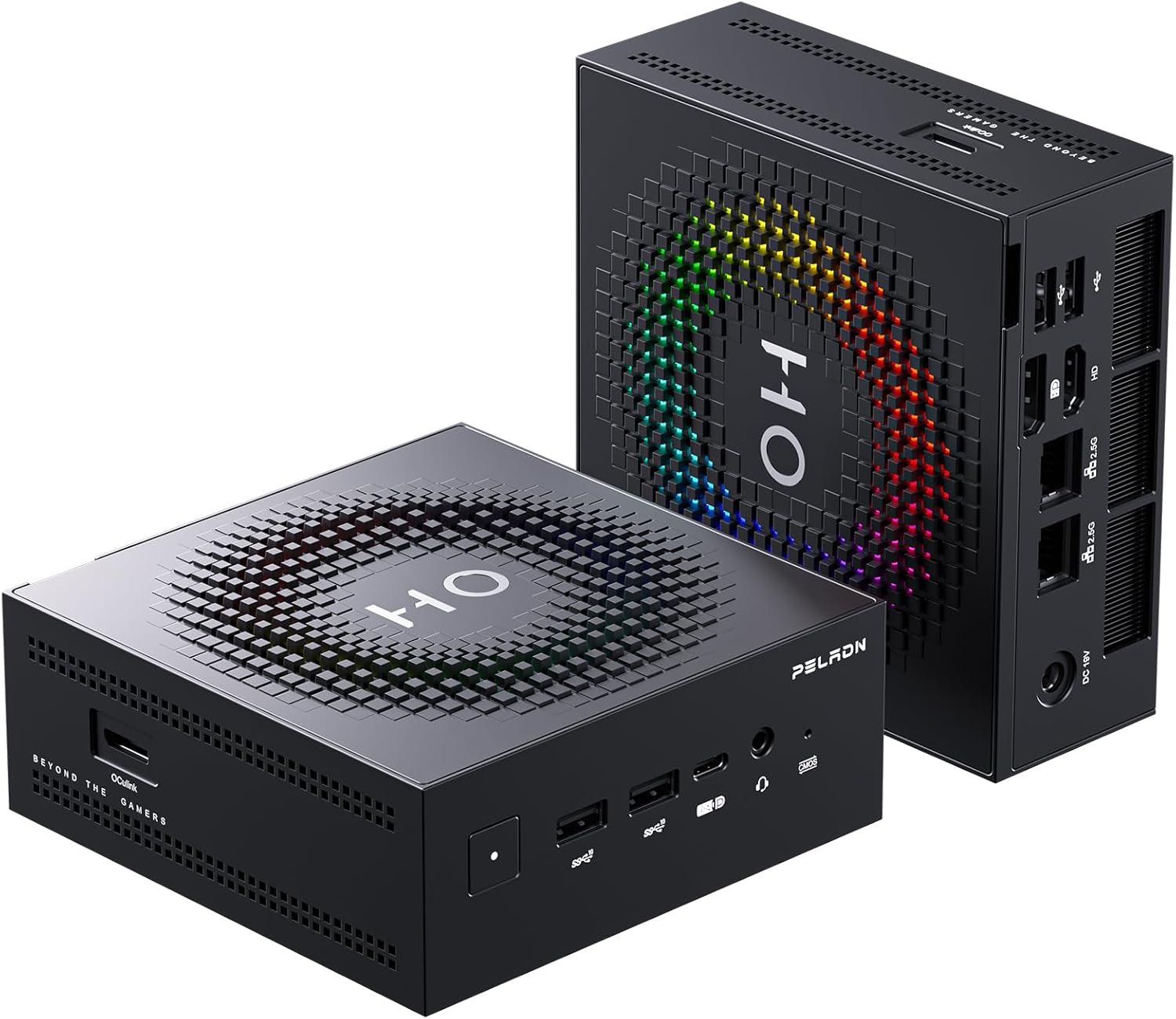
Peladn HO5 — Ryzen AI 9 HX 370 · 32GB LPDDR5X · 50 TOPS · OCuLink
The Peladn HO5 is the sweet spot for most local AI users. Its 32GB of LPDDR5X-7500 unified RAM handles every model from 7B to 32B without proxy files or memory pressure. Mistral 7B at 30–40 tokens/sec is fast enough that conversations feel natural and responsive — far better than a slow cloud connection. Qwen3 32B at 8–12 t/s is usable for longer tasks like document summarisation, coding assistance, and drafting where you’re patient enough for slightly slower responses.
The OCuLink port is the key long-term advantage: as open-source models improve and eGPU docks become more affordable, you can add a dedicated GPU later for significantly faster inference on smaller models (an RTX 4060 via OCuLink achieves 80–100 t/s on Mistral 7B). The 50 TOPS NPU unlocks the full Copilot+ Windows AI feature set alongside Ollama — background blur in video calls, Live Captions, and Windows Recall all run simultaneously without impacting LLM inference speed.
| CPU | AMD Ryzen AI 9 HX 370 — 12C/24T — up to 5.1 GHz |
|---|---|
| GPU (iGPU) | Radeon 890M — 16 CU — RDNA 3.5 |
| RAM | 32GB LPDDR5-7500 — unified — soldered |
| NPU | XDNA 2 — 50 TOPS — Copilot+ certified |
| eGPU | OCuLink PCIe 4.0 ×4 — future GPU upgrade path |
| Networking | Wi-Fi 7 · Dual 2.5GbE · USB4 40Gbps |
| Max LLM (Q4) | Qwen3 32B — 70B+ requires 128GB (EVO-X2) |
AI performance ratings
| Model | Quantization | Speed (t/s) | RAM used |
|---|---|---|---|
| Mistral 7B | Q4_K_M | 30–40 | ~6 GB |
| Qwen3 14B | Q4_K_M | 18–25 | ~10 GB |
| Qwen3 32B | Q4_K_M | 8–12 | ~22 GB |
| Llama 3.1 70B | Q4_K_M | Does not fit (needs 40GB+) | — |
✓ Pros
- Best value for 7B–32B local AI at $940
- 30–40 t/s on Mistral 7B — genuinely interactive
- OCuLink — eGPU upgrade path for future speed boost
- 50 TOPS NPU — full Copilot+ AI features
- Wi-Fi 7 + dual 2.5GbE — excellent connectivity
✕ Watch out
- 32GB soldered — cannot run 70B+ models
- Qwen3 32B at 8–12 t/s feels slow for impatient users
- Smaller brand than Beelink — shorter warranty
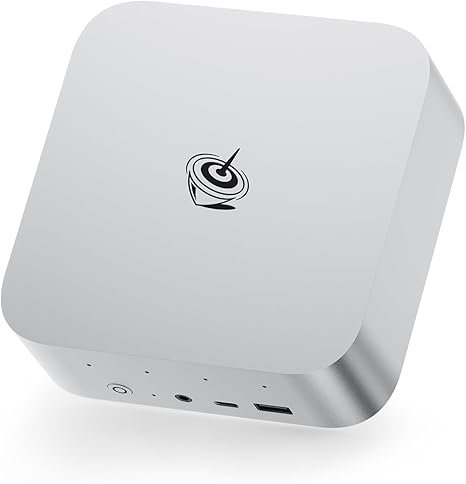
Beelink SER9 Pro AI — Same HX 370 Performance · 3-Year Warranty · Trusted Brand
The Beelink SER9 Pro AI delivers identical LLM inference performance to the Peladn HO5 — same Ryzen AI 9 HX 370, same 50 TOPS NPU, same Radeon 890M handling Vulkan-accelerated inference. The differentiator is everything around the AI performance: Beelink’s established brand reputation, wider community support and BIOS history, and better long-term driver compatibility than newer brands. For users who value reliability and don’t want to troubleshoot an unknown brand’s firmware quirks, Beelink is the lower-risk choice.
A useful bonus for AI users who also work from home: the SER9 Pro AI includes four front-facing AI microphones with 360° pickup and noise cancellation plus dual speakers. If you’re running a local AI assistant (via Open WebUI or a similar chat interface) and taking video calls simultaneously, you don’t need a separate USB mic — the built-in array handles both. The main trade-off vs Peladn HO5: no OCuLink, which limits future eGPU upgrade options to USB4 (with the associated bandwidth penalty).
| CPU | AMD Ryzen AI 9 HX 370 — 12C/24T — up to 5.1 GHz |
|---|---|
| GPU (iGPU) | Radeon 890M — 16 CU — RDNA 3.5 |
| RAM | 32GB LPDDR5X-7500 — unified — soldered |
| NPU | XDNA 2 — 50 TOPS — Copilot+ certified |
| Audio | 4× AI microphones · 360° pickup · dual speakers |
| Networking | Wi-Fi 6E · 2.5GbE · USB4 40Gbps |
✓ Pros
- Beelink — one of the most trusted mini PC brands
- Identical AI performance to Peladn HO5
- 4× AI microphones — built-in for voice AI / video calls
- Better BIOS + driver support history
- 50 TOPS NPU — Copilot+ certified
✕ Watch out
- No OCuLink — USB4 eGPU only (lower performance ceiling)
- 32GB soldered — same model size limitation as HO5
- Slightly more expensive than Peladn HO5 for same AI performance
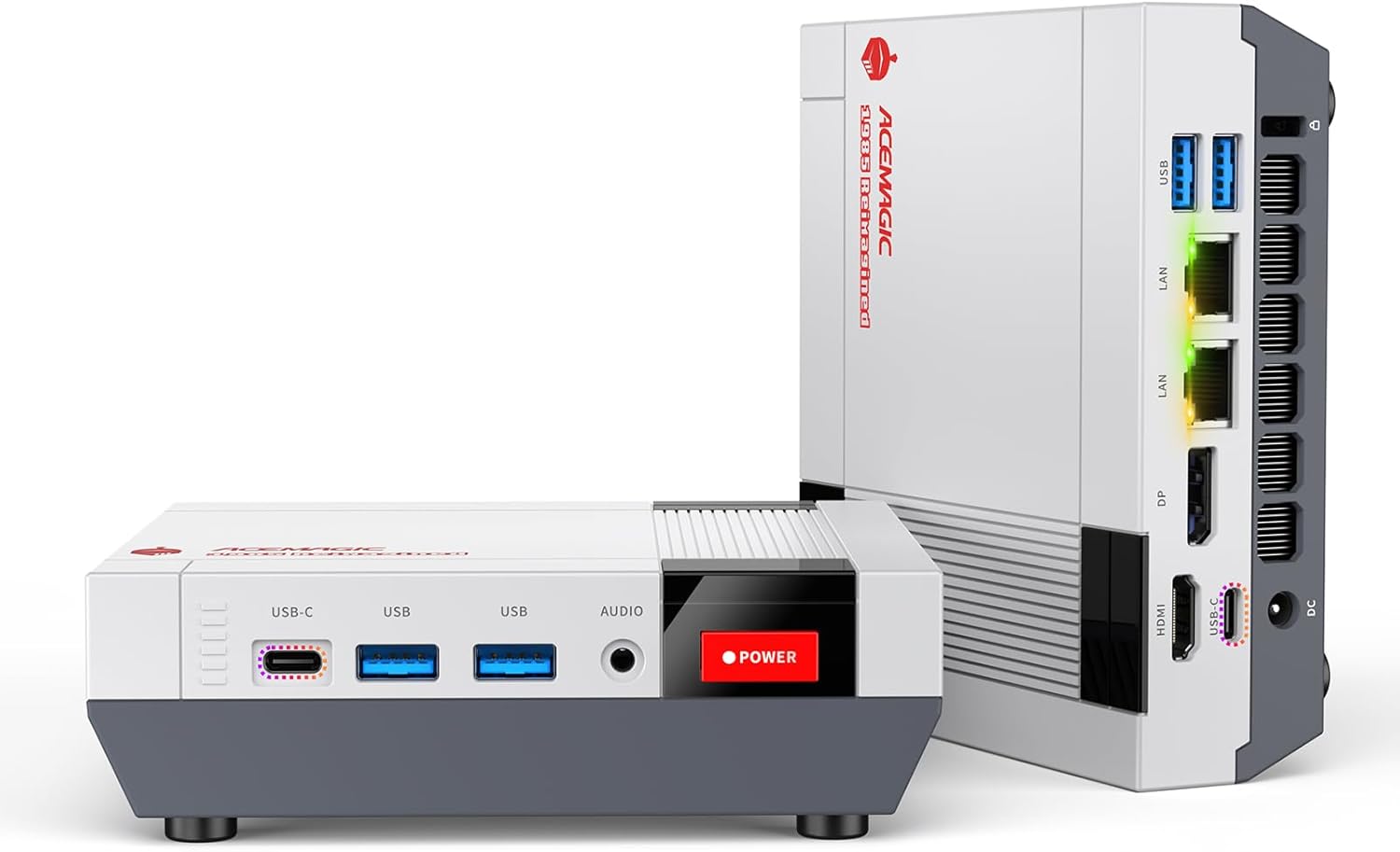
ACEMAGIC Retro X5 — Ryzen AI 9 HX 370 · 32GB → 128GB SO-DIMM · Unique Upgrade Path
The ACEMAGIC Retro X5 solves the main limitation of every other HX 370 mini PC: soldered RAM. Its user-accessible SO-DIMM slots support up to 128GB of DDR5 — meaning you can buy it today with 32GB for Mistral 7B and Qwen3 32B, then upgrade the RAM modules when you’re ready for 70B models. No other Ryzen AI 9 HX 370 mini PC offers this flexibility. The tool-less lid makes the upgrade genuinely simple: flip the lid, swap the SO-DIMMs.
The key trade-off to understand: DDR5 SO-DIMM bandwidth (~90 GB/s in dual-channel) is significantly lower than the LPDDR5X in the Peladn HO5 or EVO-X2. At 32GB, Mistral 7B runs at ~28–36 t/s versus 30–40 on the HO5. At 128GB with a RAM upgrade, Llama 3.1 70B runs at ~5–8 t/s versus 18–25 t/s on the EVO-X2. The Retro X5 is the right choice if you want the option to run large models later without paying for 128GB today — accepting slightly lower speed in exchange for flexibility.
| CPU | AMD Ryzen AI 9 HX 370 — 12C/24T — up to 5.1 GHz |
|---|---|
| RAM | 32GB DDR5 SO-DIMM — user upgradeable to 128GB |
| NPU | XDNA 2 — 50 TOPS — Copilot+ certified |
| RAM Bandwidth | ~90 GB/s dual-channel — lower than LPDDR5X options |
| Connectivity | USB4 40Gbps · Wi-Fi 7 · 1 TB NVMe |
| Max LLM at 32GB | Qwen3 32B Q4 |
| Max LLM at 128GB | Llama 3.1 70B Q4 (~5–8 t/s) |
✓ Pros
- Only HX 370 mini PC with user-upgradeable SO-DIMM slots
- Start at 32GB — upgrade to 64GB or 128GB as needed
- Tool-less lid — simple RAM swap
- 50 TOPS NPU — Copilot+ certified
- Can eventually run 70B models after upgrade
✕ Watch out
- DDR5 SO-DIMM bandwidth ~90 GB/s — slower AI inference than LPDDR5X
- 128GB DDR5 SO-DIMM upgrade kit costs ~$200–$300 additional
- ACEMAGIC is a newer brand — less established support history
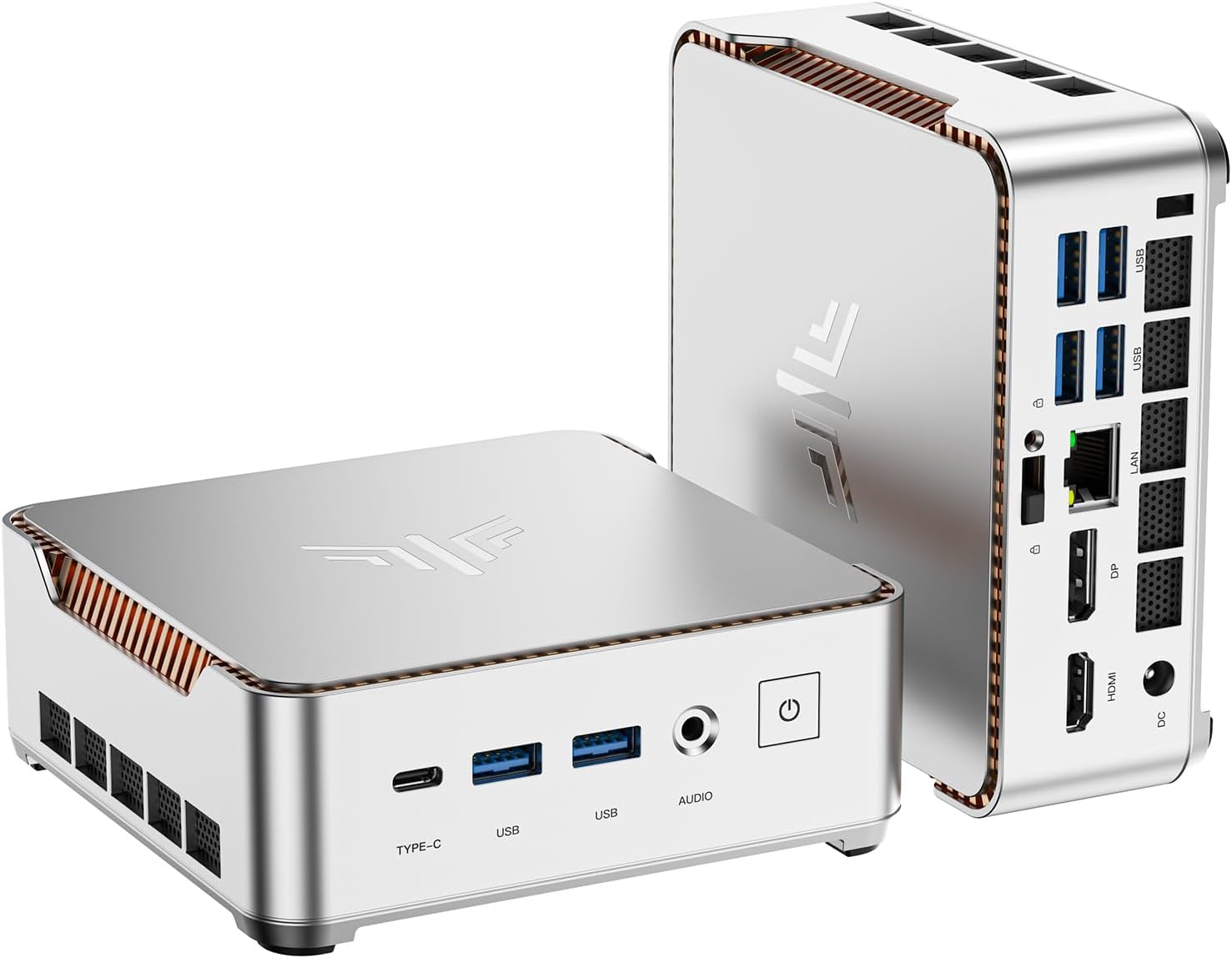
KAMRUI Pinova P2 — $329 · Triple 4K · Best Budget for Cloud AI Workflows
The KAMRUI Pinova P2 is the honest answer for users who want an AI-friendly mini PC on a tight budget. It runs local 7B models (Mistral 7B, Qwen3 7B) only at CPU inference speed — roughly 3–8 tokens/sec — which is too slow for comfortable interactive use. Its real value for AI users is different: a clean, quiet, VESA-mountable triple 4K desktop for power users who primarily use cloud AI (ChatGPT, Claude, Gemini) and want a capable, low-cost base machine for that workflow. The 16GB RAM is also upgradeable to 64GB, which improves small model performance modestly.
Who this is NOT for: anyone who wants to run local LLMs interactively. The Ryzen 4300U has no dedicated NPU (no Copilot+ features), and CPU inference of 7B models at 3–8 t/s is frustratingly slow compared to GPU-accelerated inference on HX 370 machines. Who this IS for: users whose AI workflow is 100% cloud-based and who want a capable, quiet, multi-monitor desktop at $329 for web browsing, Office, and Zoom.
| CPU | AMD Ryzen 4300U — 4C/4T — Zen 2 — 2020 |
|---|---|
| NPU | None — not Copilot+ certified |
| RAM | 16GB DDR4 — upgradeable to 64GB SO-DIMM |
| Local LLM | CPU inference only — ~3–8 t/s on 7B models |
| Best AI use | Cloud AI (ChatGPT, Claude) via browser — no local inference |
| Display | Triple 4K@60Hz — HDMI 2.0 + DP 1.4 + USB-C |
✓ Pros
- $329 — most affordable option in this ranking
- Triple 4K@60Hz — unique at this price
- VESA mountable — zero desk footprint
- 16GB DDR4 upgradeable to 64GB
- Quiet under light AI/web workloads
✕ Watch out
- No NPU — not Copilot+ certified
- Local LLM at 3–8 t/s — too slow for interactive use
- Not for users who want offline AI or privacy-first LLMs
- Ryzen 4300U is 2020 architecture — two generations behind
Explore More Mini PC Rankings
Gaming, coding, video editing and budget — every use case covered with real benchmark data and honest reviews.
Your Questions — Best Mini PCs for AI 2026
ollama run llama3 — ollama.com), and llama.cpp with the Vulkan backend (fastest on AMD GPUs). All three are free, support GGUF models from Hugging Face, and work on Windows 11. On AMD mini PCs (HX 370, AI Max), Vulkan backend gives the best inference speed.