
GMKtec EVO-X2 Review: Strix Halo — 1440p Gaming + 235B AI for $1,999
The GMKtec EVO-X2 is the most capable mini PC available in 2026. With the AMD Ryzen AI Max+ 395 (Strix Halo), 128GB LPDDR5X-8000, and a Radeon 8060S iGPU capable of genuine 1440p gaming — and 96GB of allocatable VRAM for local AI — it does things no other mini PC can do. Here’s the honest picture of what it delivers and who it’s actually for.
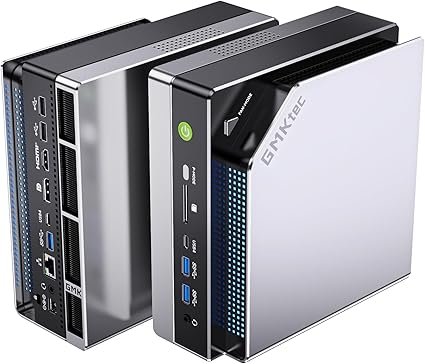
The GMKtec EVO-X2 is the best mini PC available in 2026 for two specific use cases: 1440p gaming without a dedicated GPU, and running large AI models (70B–235B) locally. Its Radeon 8060S iGPU delivers ~85 fps in Cyberpunk 2077 at 1440p High with FSR — comparable to a desktop RTX 4060. Its 128GB LPDDR5X allows 96GB as GPU VRAM, enabling Qwen3 235B at ~11 t/s. The $1,999 price is high. If you need either of these capabilities, there is no alternative at this price.
What Is Strix Halo — and Why It Matters for This Review
Strix Halo is AMD’s codename for the Ryzen AI Max series. It combines up to 16 Zen 5 CPU cores with a 40 Compute Unit RDNA 3.5 iGPU (Radeon 8060S) and up to 128GB of LPDDR5X in a unified memory architecture — meaning the CPU and GPU share the same physical RAM, with no PCIe bandwidth bottleneck between them.
The key innovation is what happens to GPU memory. In a conventional desktop, a GPU is limited to its onboard VRAM — 8GB on an RTX 4060, 16GB on an RTX 4080. In the Strix Halo architecture, the GPU can use the entire shared memory pool as VRAM. In the EVO-X2’s 128GB configuration, up to 96GB can be dynamically allocated as GPU VRAM — more than any consumer discrete GPU provides.
This changes two things fundamentally. For gaming: the GPU never runs out of VRAM, even at 4K with high-res texture packs. For local AI: models that require 40–90GB of GPU memory — like Llama 3.1 70B or Qwen3 235B — can run entirely in memory without CPU offloading, which is the main reason these models are slow or impossible on other hardware.
Full Specifications
The EVO-X2 ships in two configurations: 64GB + 1TB ($1,499) and 128GB + 2TB ($1,999). For local AI use cases requiring 70B+ models, the 128GB version is the only viable choice.
| CPU | AMD Ryzen AI Max+ 395 — 16C/32T — Zen 5 — up to 5.1 GHz — 120W TDP |
|---|---|
| GPU (integrated) | Radeon 8060S — 40 CU — RDNA 3.5 — up to 2.9 GHz — 256 GB/s bandwidth |
| NPU | XDNA 2 AI Engine — 50 TOPS |
| RAM | 128GB LPDDR5X-8000 — soldered — up to 96GB allocatable as VRAM |
| Storage | 2TB M.2 NVMe PCIe 4.0 — 2nd M.2 slot available |
| Display outputs | HDMI 2.1 + DisplayPort 1.4 + 2× USB4 (DisplayPort Alt) — up to 4 displays simultaneously |
| USB | 2× USB4 (40 Gbps, DP Alt, eGPU) · 2× USB-A 3.2 Gen2 · USB-C 3.2 Gen2 |
| Networking | 2.5 Gigabit Ethernet · Wi-Fi 7 · Bluetooth 5.4 |
| Audio | 3.5mm combo jack |
| PSU | 230W external power brick |
| OS | Windows 11 Pro (pre-installed) |
| Dimensions | Approx. 200×190×60mm — vertical orientation — ~1.6 kg |
| Price (128GB) | $1,999 on Amazon |
Design, Size & Build Quality
The EVO-X2 is notably larger than a standard mini PC — approximately the footprint of two stacked paperback books. It runs vertically and weighs around 1.6 kg. The thermal system is a serious piece of engineering: dual blowers and a large heatsink manage the 120W TDP.
The chassis is a matte black aluminum design that looks professional on a desk. It’s significantly larger than the Beelink SER9 Pro AI or Peladn HO5 — the difference is visible and meaningful if desk space is constrained. Under light-to-medium load, the EVO-X2 is quiet. Under sustained gaming or AI inference at full TDP, the fans are audible — not intrusive, but present.
Port placement is well thought out: all data ports and display outputs are on the rear, keeping cable clutter behind the machine. The front panel has USB-A and a USB-C port for quick peripheral access. The 230W power brick is substantial — budget desk space accordingly.
CPU & General Performance
The Ryzen AI Max+ 395’s 16 Zen 5 cores deliver desktop-class CPU performance. In Cinebench R23, community results report approximately 35,000–37,000 points multi-core — competitive with a desktop Ryzen 9 7900X.
| Benchmark | EVO-X2 Score | Context |
|---|---|---|
| Cinebench R23 Multi | ~35,000–37,000 | Competitive with desktop Ryzen 9 7900X |
| Cinebench R23 Single | ~2,100–2,200 | Strong single-core — benefits gaming and latency-sensitive work |
| 3DMark Time Spy | ~11,000–12,000 | Radeon 8060S — RTX 4060 desktop class |
| 3DMark Steel Nomad | ~22,000 | Mid-tier desktop level |
| PCMark 10 | ~8,500 | Excellent for productivity |
* Benchmark figures from community reports on r/MiniPCs and published reviews. Results may vary by configuration and driver version.
For everyday productivity, the EVO-X2 is faster than any other mini PC in this form factor. Compiling code, running virtual machines, video editing — the 16 cores with Zen 5 IPC handle all of it without constraint. The 50 TOPS NPU also accelerates Windows Copilot+ features (live captions, AI image generation, semantic search) natively in the background.
Gaming Performance — Can It Really Game at 1440p?
Yes — the Radeon 8060S delivers genuine 1440p gaming performance in most current titles, without a discrete GPU. Community benchmarks report approximately 85 fps in Cyberpunk 2077 at 1440p High with FSR, and over 130 fps in Counter-Strike 2 at 1440p. This is RTX 4060 desktop territory.
| Game | Settings | Avg FPS | Notes |
|---|---|---|---|
| Cyberpunk 2077 | 1440p High + FSR Quality | ~85 fps | Very playable — smooth experience |
| Cyberpunk 2077 | 1440p Ultra + FSR3 FG | >120 fps | With Frame Generation enabled |
| Red Dead Redemption 2 | 1440p High | ~70 fps | GPU-intensive — strong result for iGPU |
| Counter-Strike 2 | 1440p High | ~130–160 fps | Excellent competitive performance |
| Elden Ring | 1440p High | ~80 fps | Very playable |
| Fortnite | 1440p Epic + DLSS | ~90–110 fps | Strong with upscaling |
| 4K gaming | Native 4K | ~30–50 fps | Playable at medium settings with FSR |
* Gaming benchmarks from community testing on Strix Halo platforms (EVO-X2 and comparable configurations). Actual results depend on TDP settings, driver version, and game patch.
Local AI Capabilities — The Real Differentiator
The EVO-X2’s 128GB unified memory and 96GB VRAM allocation make it the only consumer mini PC capable of running 70B–235B AI models at interactive speeds. Community benchmarks report ~18–25 tokens/sec on Llama 3.1 70B (Q4) and ~11 tokens/sec on Qwen3 235B (Q2).
| Model | Quantization | Speed (t/s) | VRAM Used | Quality |
|---|---|---|---|---|
| Mistral 7B | Q4_K_M | 55–65 t/s | ~6 GB | Excellent |
| Qwen3 14B | Q4_K_M | 35–45 t/s | ~10 GB | Excellent |
| Qwen3 32B | Q4_K_M | 25–35 t/s | ~22 GB | Excellent |
| Llama 3.1 70B | Q4_K_M | 18–25 t/s | ~42 GB | Excellent |
| Qwen3 235B | UD-Q2_K_XL | ~11 t/s | ~88 GB | Good (Q2 compression) |
| Stable Diffusion XL | ComfyUI / Vulkan | 3–5 img/min | ~6 GB | Full quality |
* AI inference figures from community benchmarks on r/LocalLLaMA for Strix Halo platforms. Use Ollama, LM Studio, or llama.cpp with Vulkan backend for best results on AMD.
The 11 tokens/second on Qwen3 235B deserves context: this is a model with 235 billion parameters that, until Strix Halo, required a multi-GPU server setup costing $15,000+. At 11 tokens/second, conversations feel like slow typing pace — usable for research and writing, less comfortable for fast back-and-forth chat. For the Llama 3.1 70B at 18–25 t/s, the experience is genuinely interactive.
Who Is the GMKtec EVO-X2 For?
Pros & Cons
✓ What We Like
- Radeon 8060S — genuine 1440p gaming without dedicated GPU
- 96GB allocatable VRAM — runs Qwen3 235B and Llama 3.1 70B
- 256 GB/s memory bandwidth — fast AI inference
- 16C/32T Zen 5 — desktop-class CPU performance
- 50 TOPS NPU — Windows Copilot+ AI features
- Wi-Fi 7 + 2.5GbE + dual USB4 + HDMI 2.1
- Cheapest Strix Halo access ($1,999 vs $2,400+ alternatives)
- Windows 11 Pro included
✕ Watch Out For
- $1,999 — significant premium over HX 370 mini PCs (~$940)
- Soldered RAM — no upgrade path after purchase
- Larger & heavier than standard mini PCs
- Fans audible under full TDP gaming/AI load
- Qwen3 235B at Q2 — quality noticeably worse than Q4
- USB4 eGPU only — no OCuLink port
Final Verdict
Performance Ratings
The GMKtec EVO-X2 does two things no other mini PC can do: it plays games at 1440p without a discrete GPU, and it runs frontier-class AI models locally on a device the size of a book. If you need either of those capabilities, the $1,999 price is justified — because there is no cheaper way to get them.
If you primarily need a capable everyday mini PC for office work, coding, and running 7B–32B AI models, a Ryzen AI 9 HX 370 mini PC at ~$940 covers 95% of use cases at half the price. The EVO-X2’s premium is real and it’s for a specific audience. Know which one you are before buying.
Frequently Asked Questions
Gaming benchmark figures are sourced from community testing on r/MiniPCs, r/LocalLLaMA, and published Strix Halo platform reviews. AI inference performance is based on llama.cpp community benchmarks. This review is based on published specifications and platform data — no sample unit was provided. This article contains affiliate links — we earn a commission on qualifying purchases at no extra cost to you.