
NVIDIA DGX Spark: The Desktop AI Supercomputer That Runs 200 Billion Parameter Models
The DGX Spark fits on a desk, plugs into a standard wall outlet, and runs 200-billion-parameter AI models — no cloud, no datacenter. Powered by the GB10 Grace Blackwell Superchip and 128GB of unified memory, it redefines what a workstation can do with local AI.
Affiliate Disclosure: This article contains affiliate links. MiniPCDeals.net participates in the Amazon Associates program and may earn a commission on qualifying purchases at no extra cost to you. This does not affect the information presented here, which is based entirely on manufacturer-published specifications.
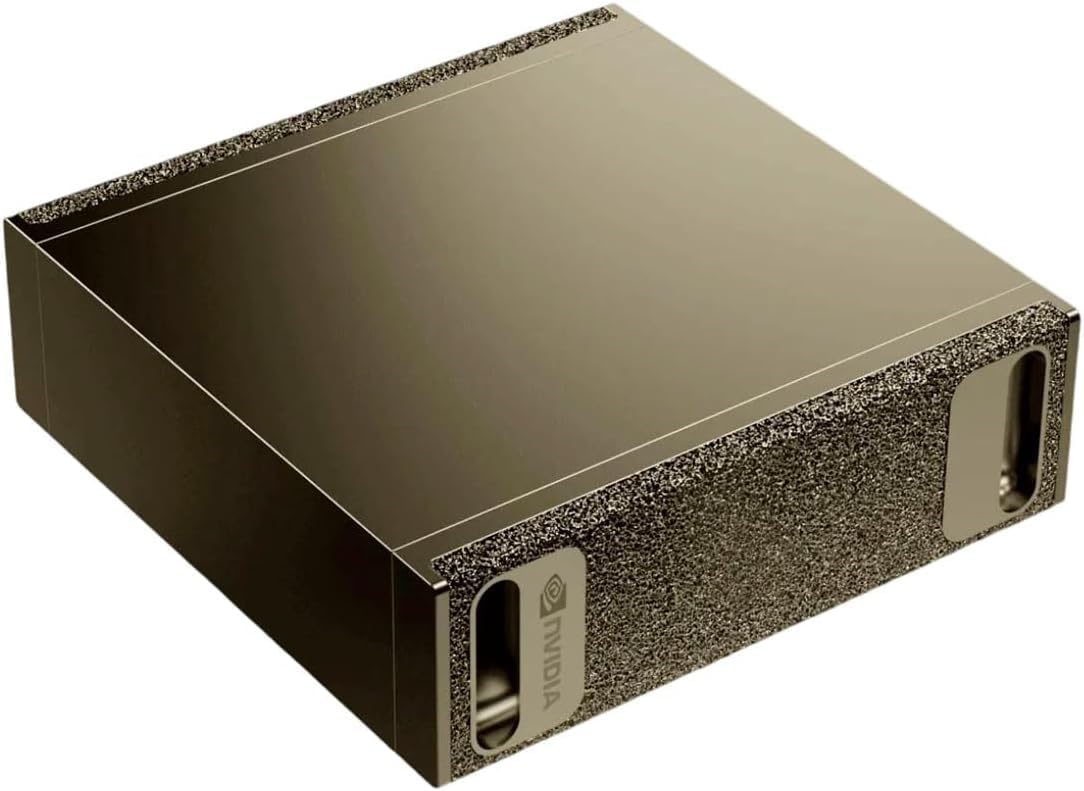
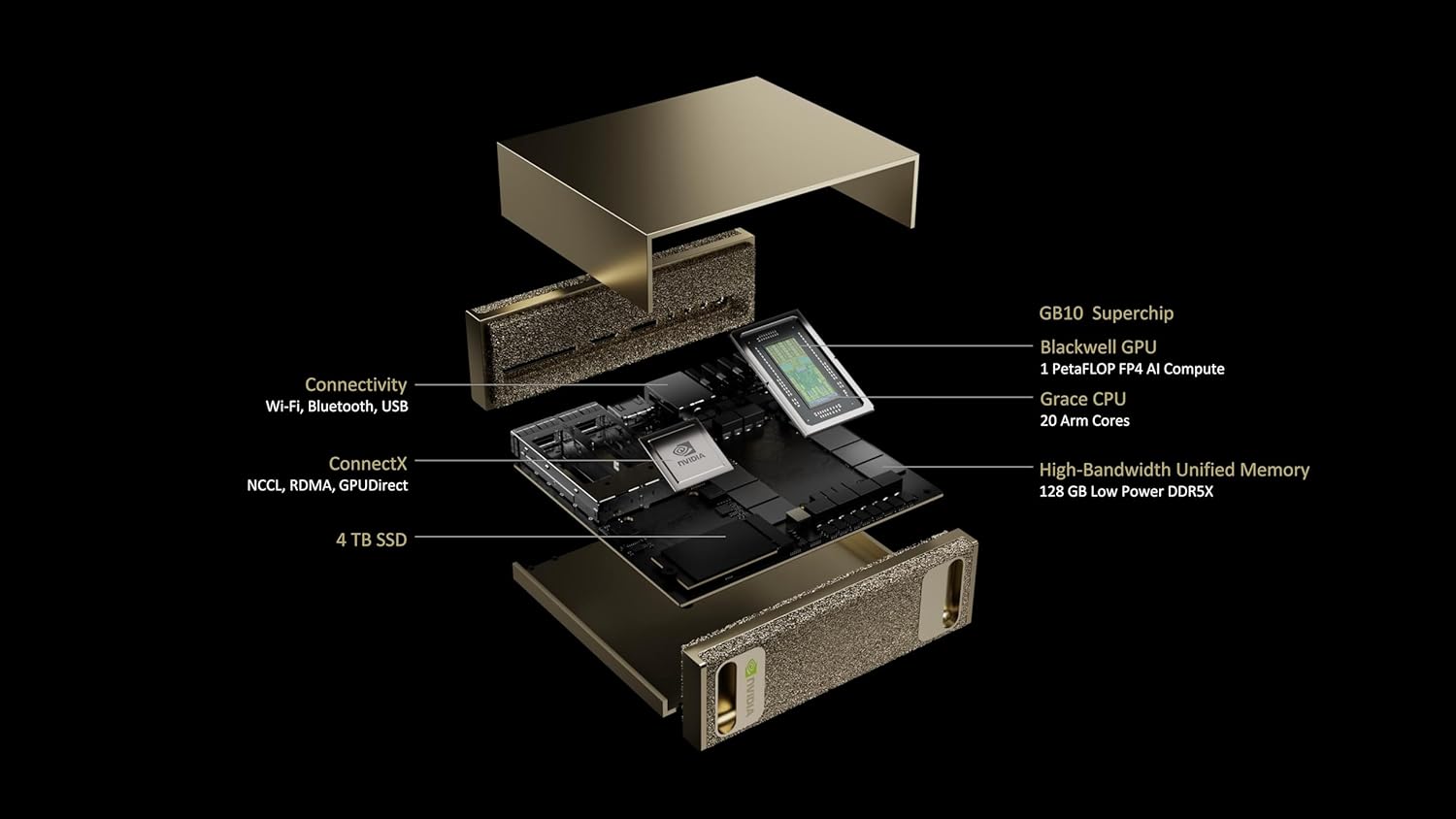
The NVIDIA DGX Spark is a compact desktop computer purpose-built for local AI, built around the GB10 Grace Blackwell Superchip. It pairs a 20-core Arm CPU, a Blackwell GPU with 6,144 CUDA cores, 128GB of unified memory, and a 200 Gb/s ConnectX-7 network interface. Its purpose: run models up to 200 billion parameters (405 billion when clustering two units) and host always-on autonomous AI agents, right on your desk.
What Is the DGX Spark?
The DGX Spark is NVIDIA’s smallest Grace-Blackwell workstation. It sits on a desk, plugs into a standard outlet, and runs agentic AI workloads that previously required a server or cloud access.
Originally announced under the codename Project DIGITS at CES, the DGX Spark was renamed ahead of its official launch. Its goal is straightforward: give developers, researchers, and data scientists a complete, pre-configured local AI environment without the friction of a datacenter.
Unlike a typical mini PC, the DGX Spark is not aimed at consumers. It does not run Windows — it runs DGX OS, an Ubuntu-based Linux distribution, with NVIDIA’s AI Enterprise software stack preinstalled. This is a specialized work tool, not a family computer.
The GB10 Superchip will also power future RTX Spark platforms, which will target a broader audience with Windows. The DGX Spark itself remains positioned for professional AI development on Linux.
Full Specifications
| Processor | NVIDIA GB10 Grace Blackwell Superchip — Arm v9.2 CPU · 20 cores (10× Cortex-X925 + 10× Cortex-A725) |
|---|---|
| GPU | Blackwell · 6,144 CUDA cores · 5th-gen Tensor Cores · 1 PFLOP FP4 sparse |
| Memory | 128GB LPDDR5X coherent unified memory — 273 GB/s bandwidth |
| Storage | Up to 4TB NVMe M.2 self-encrypting |
| Networking | ConnectX-7 Smart NIC · 200 Gb/s RDMA · 10 GbE · Wi-Fi 7 · Bluetooth 5.3 |
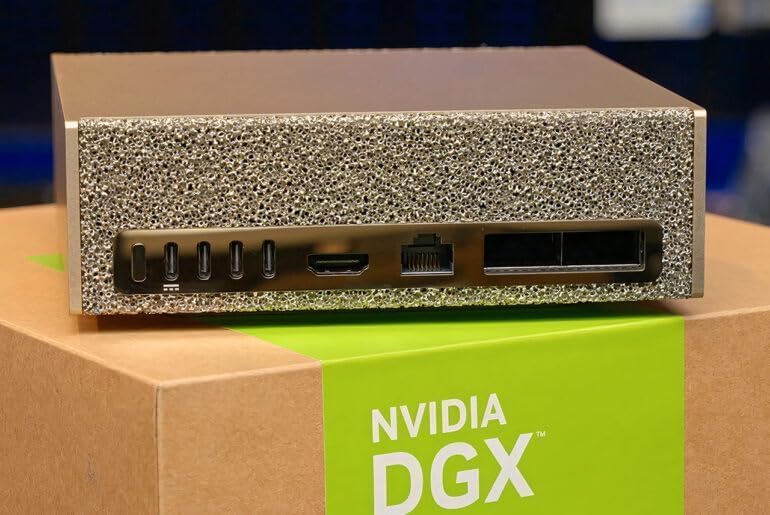
| Ports | 4× USB4 Type-C · HDMI 2.1a (8K) · Ethernet |
| OS | DGX OS (Ubuntu) + NVIDIA AI Enterprise stack preinstalled |
| Power | 170W typical · 224W peak |
| Cooling | Passive — silent design |
| Dimensions | 150 × 150 × 50.5 mm · 1.2 kg |
The GB10 Grace Blackwell Explained
The GB10 Superchip is a miniaturized version of the Grace-Blackwell platform used in NVIDIA’s NVL72 rack systems. It combines two dies — one for the CPU and memory, one for the GPU — linked by NVLink-C2C at 600 GB/s and fabricated on TSMC’s 3nm process.
The GB10’s CPU does not use the Neoverse V2 cores found in the mainstream Grace lineup. It was co-designed with MediaTek and packs 20 Armv9.2 cores: 10 high-performance Cortex-X925 cores and 10 efficient Cortex-A725 cores. Each cluster has 16MB of L3 cache, for 32MB total.
On the GPU side, the integrated Blackwell offers 6,144 CUDA cores and fifth-generation Tensor Cores, with native support for the NVFP4 format — a proprietary 4-bit format that dramatically reduces model memory footprint and accelerates inference by cutting data transfers.
The GB10 uses LPDDR5X memory with 273 GB/s of bandwidth. That’s roughly 3× less than the Mac Studio M4 Ultra (819 GB/s) and 6.5× less than an RTX 5090 (1,792 GB/s). This limitation is offset by the NVFP4 format, which reduces the amount of data that needs to move. Understand this clearly: the DGX Spark’s strength is not raw speed, it’s memory capacity.
Unified Memory: Why It Matters
The DGX Spark’s 128GB of coherent unified memory is shared between the CPU and GPU. That means a 120-billion-parameter model can be fully loaded into memory and run locally — something impossible on an RTX 5090, which caps out at 32GB of VRAM.
To understand the point, it helps to grasp the fundamental constraint of desktop local AI: it’s not compute power that blocks you, it’s memory capacity. A 70B model in FP16 precision requires roughly 140GB of memory. A consumer graphics card tops out at 24 or 32GB.
The DGX Spark solves this problem through its unified memory architecture. Here’s what that enables in practice:
- Inference: run models up to 200 billion parameters on a single unit
- Fine-tuning: fine-tune models up to 70 billion parameters (LoRA, QLoRA, full fine-tuning)
- Clustering: connect two units to reach 405 billion parameters
- Data science: process large datasets with RAPIDS and cuDF directly in GPU memory
ConnectX-7 and Clustering
Every DGX Spark includes a ConnectX-7 card with dual QSFP56 cages, delivering up to 200 Gb/s of RDMA bandwidth. This datacenter-grade feature allows two units to be connected directly, without a switch.
This is one of the most unusual aspects of a desktop machine. Having a genuine datacenter interconnect opens the door to multi-node configurations that were previously reserved for racks. NVIDIA officially validates three configurations:
- Single unit: individual desktop work
- 2-unit cluster: direct link over a 200 Gb/s port, for models up to 405B
- 4-unit cluster: demonstrated publicly, to push the limits further
A two-unit cluster test showed throughput ranging from 17 tok/s to over 720 tok/s depending on batch size and model partitioning strategy. Four-unit configurations have also been demonstrated, though NVIDIA positions the two-unit cluster as the reasonable ceiling for production inference on this hardware.
NVIDIA DGX Spark — GB10 Grace Blackwell · 128GB unified · 1 PFLOP FP4
Available on Amazon. Fixed configuration: 128GB memory, up to 4TB NVMe storage.
Use Cases
The DGX Spark is designed for five main workload categories: prototyping, fine-tuning, large-model inference, data science, and edge applications. It is not a gaming machine or an office PC.
Prototyping and Development
Develop, test, and validate AI models and applications locally, with the ability to migrate later to DGX Cloud or accelerated infrastructure without rewriting code. The preinstalled stack includes PyTorch, TensorFlow, and RAPIDS.
Fine-tuning
Fine-tune models up to 70 billion parameters thanks to the 128GB of unified memory. LoRA, QLoRA, and full fine-tuning methods are supported. As a reference point, QLoRA fine-tuning of a Llama 3.3 70B peaked at over 5,000 tokens/second on this platform.
Large-Model Inference
Run reasoning models up to 200 billion parameters locally. NVFP4 support from fifth-generation Tensor Cores accelerates inference on frontier models while reducing memory footprint.
Data Science
Combine 128GB of unified memory and 1 PFLOP of parallel compute to accelerate complex data analytics and machine learning workflows directly on the desktop, with cuML and cuDF.
Edge Applications
Build applications for robotics, smart cities, and computer vision with NVIDIA’s Isaac, Metropolis, and other AI frameworks.
A documented case study shows that a single DGX Spark can serve up to 8 users on a 30B RAG (Retrieval-Augmented Generation) model during the day, then switch to LoRA fine-tuning at night. A 500-step training run finished in about 45 minutes, without any data leaving the building.
Software Stack and NemoClaw
The DGX Spark ships with DGX OS and the NVIDIA AI Enterprise stack preinstalled: PyTorch, TensorFlow, RAPIDS, and the NGC registry. A recent DGX OS update adds streamlined installation of NemoClaw, the open-source reference stack for running secure autonomous agents.
NVIDIA also announced NemoClaw, an open-source stack that adds security and privacy guardrails to OpenClaw via OpenShell. The goal is to let developers build and deploy safer autonomous agents — capable of reading files, calling APIs, and executing multi-step workflows — entirely locally, on the DGX Spark.
NemoClaw orchestrates OpenShell to run OpenClaw, a self-hosted gateway that connects messaging platforms to AI coding agents based on open models like NVIDIA Nemotron. The stack adds guided onboarding, lifecycle management, and versioned blueprints for a complete pipeline, from model inference to agent deployment.
One of the DGX Spark’s key arguments for autonomous agents is privacy. By running everything locally — models, agents, data — no information transits through a third-party cloud. For regulated sectors (healthcare, finance, research), this is a structural advantage.
Frequently Asked Questions
Sources & Notes
Specifications sourced from NVIDIA’s official product listing and technical documentation (GB10 Grace Blackwell, DGX OS, ConnectX-7). Fine-tuning and inference performance figures from benchmarks published by NVIDIA Developer and community reports (r/LocalLLaMA, DevelopersIO). Information on NemoClaw, OpenShell, and OpenClaw from NVIDIA developer blogs. This content is informational and based on manufacturer- and community-published data.