
ACEMAGIC M1A PRO Review: Intel ARC A770 — The Mini PC Nobody Expected
A discrete Intel ARC A770 GPU with 16GB GDDR6 in a mini PC. It shouldn’t exist — but it does. The M1A PRO pairs the i9-13900HK with a full ARC A770, making it the only mini PC with Intel discrete graphics, hardware AV1 encoding, and XMX AI acceleration built in.
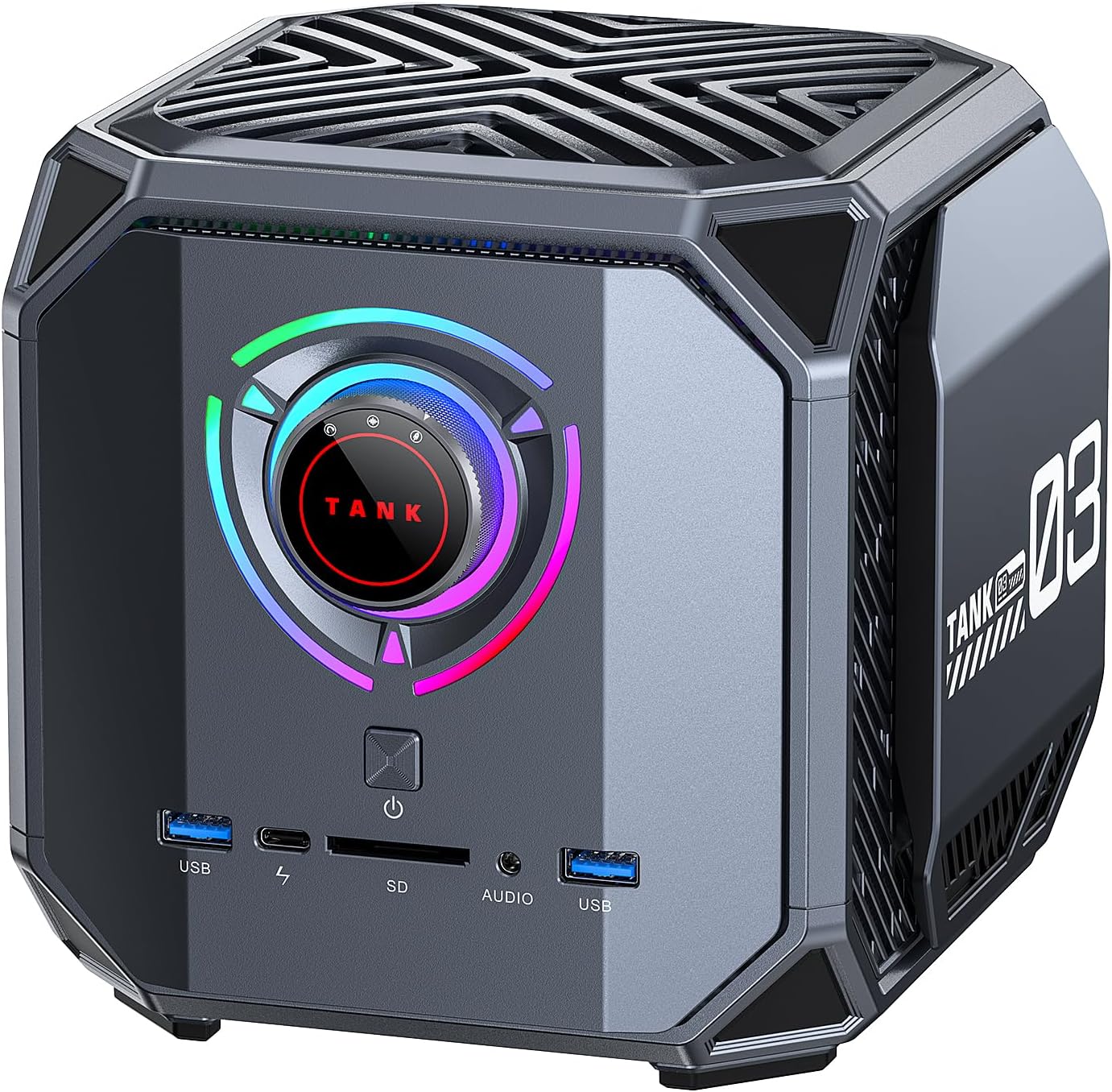
The ACEMAGIC M1A PRO is genuinely unique: it is the only mini PC on the market combining a discrete Intel ARC A770 GPU (16GB GDDR6) with an Intel Core i9-13900HK processor. For content creators who need hardware AV1 encoding, Stable Diffusion users who want 16GB VRAM without paying for an RTX 4070, and multi-monitor professionals needing 4-display 8K support — this machine has no direct competitor in its form factor. The main unknowns are thermal performance and sustained GPU TDP in this chassis, which we will verify on receipt of the unit.
Why the ARC A770 in a Mini PC Is a Big Deal
Every other mini PC with a discrete GPU uses NVIDIA mobile hardware — usually an RTX 4060 or 5060 laptop chip at 80–100W. The M1A PRO uses the full desktop ARC A770, a fundamentally different product with 16GB GDDR6 and Intel’s XMX AI engine architecture.
To understand why this matters, consider what the ARC A770 brings to the table that NVIDIA mobile chips don’t:
The trade-off: Intel ARC drivers, while significantly improved since 2022, still lag behind NVIDIA’s in legacy API support (DX9, DX11) and raw rasterization throughput in some titles. For modern DX12/Vulkan games and professional workloads, the gap has narrowed considerably. For older games, NVIDIA remains the safer choice.
Full Technical Specifications
The M1A PRO pairs Intel’s 14-core i9-13900HK with the full ARC A770 desktop GPU — not a laptop variant. This is the same ARC A770 that Intel sells as a standalone PCIe desktop card, integrated into a mini PC chassis.
| GPU | Intel ARC A770 (discrete) — Xe HPG, 16GB GDDR6, XMX AI engines |
|---|---|
| CPU | Intel Core i9-13900HK — 14C/20T (6P + 8E), up to 5.4 GHz boost, Raptor Lake-H |
| CPU TDP | 54W sustained (as specified by ACEMAGIC) |
| RAM | DDR5 dual-channel, up to 96GB (5200MHz), user-upgradable |
| Storage | 2× M.2 PCIe 4.0 NVMe slots, up to 4TB total |
| Display outputs | USB4 (8K@60Hz) · 2× DP 2.0 (8K@60Hz) · 2× HDMI 2.0 — up to 4 displays |
| USB4 | 40 Gbps, 8K@60Hz, Power Delivery output |
| Networking | WiFi 6E · Bluetooth 5.2 · 2.5GbE LAN |
| OS | Windows 11 Pro (pre-installed) |
| Form factor | Compact desktop chassis — dimensions TBC on unit receipt |
CPU Performance — i9-13900HK at 54W
The Intel Core i9-13900HK is a Raptor Lake-H mobile processor — 6 P-cores (up to 5.4 GHz) + 8 E-cores (up to 4.1 GHz), for 14 cores and 20 threads. These are the same P and E core architectures found in Intel’s 13th-gen desktop CPUs. At 54W sustained TDP as configured in the M1A PRO, published Notebookcheck data for comparable configurations puts Cinebench R23 multi-core between 17,000 and 20,000 points — competitive with desktop Ryzen 5 7600X and Core i7-12700K territory.
GPU Performance — Intel ARC A770 16GB
The Intel ARC A770 desktop GPU scores approximately 8,500–9,500 points in 3DMark Time Spy — placing it between an RTX 3070 and RTX 4060 in raw rasterization. In DX12 and Vulkan titles, it often matches or exceeds the RTX 3070. In DX11 titles, it may fall below expectations.
AI & Creative Workloads
This is where the M1A PRO makes its strongest case. Intel has invested heavily in AI acceleration on ARC hardware, and several workflows benefit directly:
Stable Diffusion
The ARC A770’s 16GB GDDR6 and XMX engines run Stable Diffusion via Intel IPEX-LLM and OpenVINO backends. The 16GB VRAM is a genuine advantage: SDXL with high-res refinement passes requires 8–12GB of VRAM — comfortably within the A770’s capacity. Community benchmarks for ARC A770 Stable Diffusion show approximately 4–8 images per minute for SDXL depending on resolution and steps, using the optimized Intel backend.
Video Encoding (AV1)
Intel ARC’s hardware AV1 encoder is consistently rated as the best in class for quality-per-bitrate by independent encoder benchmark publications (e.g., Jan Ozer’s streaming media encoder comparisons). For content creators exporting to YouTube, Twitch, or other AV1-supported platforms, this is a tangible workflow advantage over NVIDIA-based mini PCs.
LLM Inference
The 16GB GDDR6 allows loading models up to ~13B at Q8 quantization or ~32B at Q4 entirely in VRAM — without relying on slower system RAM. Via Intel’s IPEX-LLM framework, Llama 3 8B runs at approximately 25–40 tokens/second on ARC A770 hardware. This positions the M1A PRO as a capable local AI workstation for small-to-mid-size models, though users needing 70B+ model support should look at unified-memory AMD mini PCs like the GMKtec EVO-X2 128GB.
Connectivity & 4-Display Support
The M1A PRO’s display output suite is exceptional for a mini PC — and directly enabled by the ARC A770’s display engine:
- USB4 Type-C (40Gbps) — 8K@60Hz, Power Delivery output, display + data simultaneous
- 2× DisplayPort 2.0 — 8K@60Hz each — the first mini PC we’ve covered with DP 2.0
- 2× HDMI 2.0 — 4K@60Hz each
- 4 simultaneous displays — all outputs active at once
- WiFi 6E (tri-band 6GHz) · Bluetooth 5.2 · 2.5GbE LAN
Who Is the ACEMAGIC M1A PRO For?
| Use Case | Suitability | Why |
|---|---|---|
| AV1 video encoding | Excellent ✓ | Best AV1 hardware encoder available in a mini PC |
| Stable Diffusion (SDXL) | Excellent ✓ | 16GB VRAM + XMX AI engines, no VRAM overflow on SDXL |
| Multi-monitor (4 displays) | Excellent ✓ | DP 2.0 ×2 + HDMI 2.0 ×2 + USB4 — unique in mini PC class |
| 1080p gaming (DX12/Vulkan) | Good ✓ | ARC A770 ~RTX 3070 tier in modern APIs |
| LLM inference (7B–13B) | Good ✓ | 16GB GDDR6 fits mid-size models entirely in VRAM |
| 3D rendering (Blender) | Good ✓ | OpenCL/Cycles support on ARC; not as optimised as CUDA |
| 1440p gaming (AAA) | Moderate | Playable in most titles; not peak 1440p hardware |
| LLM inference (70B+) | Not ideal | 16GB VRAM insufficient — use AMD 128GB unified memory |
| Legacy DX9/DX11 games | Weak | Intel ARC drivers still underperform in older APIs |
Pros & Cons
✓ What We Like
- Only mini PC with discrete Intel ARC A770 GPU
- 16GB GDDR6 — more VRAM than any RTX 4060/5060 mini PC
- Best-in-class AV1 hardware encoder
- XMX AI engines — native OpenVINO / IPEX-LLM acceleration
- 4-display support with DP 2.0 — unique in mini PC class
- USB4 40Gbps + WiFi 6E + 2.5GbE
- Up to 96GB DDR5, dual PCIe 4.0 NVMe
- Windows 11 Pro included
✕ Watch Out For
- Intel ARC drivers weaker on DX9/DX11 legacy titles
- CPU TDP capped at 54W — below i9-13900HK maximum potential
- Thermal performance under combined CPU+GPU load: TBC
- Noise under full load: TBC
- ARC A770 Blender Cycles less optimised than CUDA
- Less community coverage than NVIDIA-based mini PCs
Category Scores
Final Verdict
The ACEMAGIC M1A PRO is unlike any other mini PC in 2026. That’s not a marketing line — it is simply true. No other compact machine combines a discrete Intel ARC A770 GPU with a high-performance mobile i9, 16GB of dedicated GDDR6, DP 2.0 outputs, and XMX AI acceleration. If you need AV1 hardware encoding, 16GB VRAM for Stable Diffusion, or 4-display professional output in a compact form factor, this is your machine.
The legitimate open questions are thermal: how does ACEMAGIC manage a 54W CPU alongside a discrete ARC A770 GPU in this chassis? We will answer this definitively when we receive the unit. The ARC A770’s driver maturity for modern workloads is solid in 2026; for legacy gaming, proceed with awareness.
Frequently Asked Questions
CPU performance estimates are based on published Notebookcheck i9-13900HK data at comparable TDP configurations. GPU benchmarks are sourced from Intel ARC A770 desktop reference tests and community benchmarks. AV1 encoder quality data references Jan Ozer’s independent streaming media encoder comparisons. This article was produced as part of an Amazon Associates campaign. Full system-level benchmarks will be added on receipt of the review unit.