
ACEMAGIC K5 Review: Intel Core 5 320 vs Ryzen 5 PRO 7640HS, Which K5 Should You Buy?
Search Amazon for the ACEMAGIC K5 and you will find two different computers under the same name and almost the same small box. One runs Intel’s brand-new Core 5 320, the other AMD’s Ryzen 5 PRO 7640HS. They are not the same class of machine, and the right one depends on what you do. Here is what the specifications and published tests say about each.
In short
Two K5s, two jobs. The AMD version has twice the threads, about 74% more multi-core performance and much stronger Radeon 760M graphics: the better all-rounder, and the only one for light gaming. The Intel version is the newer, more frugal design, with measured idle power around 4W, a 20Gbps USB-C port that can also power it, and a stronger NPU. Both have 16GB of soldered memory, 2.5GbE, Wi-Fi 6 and three 4K outputs. When both cost about the same, buy the AMD K5; choose the Intel K5 for a quiet, low-power office PC.
7.4 / 10
K5 with Ryzen 5 PRO 7640HS: more power for multitasking, photo work and 1080p gaming at low settings.
7.0 / 10
K5 with Intel Core 5 320: an efficient, compact office PC with modern connectivity, limited by its graphics and storage speed.
Two different mini PCs called ACEMAGIC K5
ACEMAGIC sells the K5 with an Intel Core 5 320 (also called “Kron Mini K5”) and with an AMD Ryzen 5 PRO 7640HS. Both come with 16GB of LPDDR5 and a 512GB SSD in the US, but the processors, graphics and power budgets are very different.
The Intel K5 appeared in June 2026, one of the first mini PCs with Intel’s Wildcat Lake chips, the successors to the N-series found in most budget boxes. A cheaper Core 3 304 version with 12GB of memory also exists. The AMD K5 arrived on Amazon in October 2026 with a 2023 laptop chip that is a full class above: 6 Zen 4 cores with 12 threads and Radeon 760M graphics. ACEMAGIC also sells a 24GB version of the AMD model in Japan.
| Spec | K5 Intel Core 5 320 | K5 AMD Ryzen 5 PRO 7640HS |
|---|---|---|
| Processor | Core 5 320 (Wildcat Lake, 2026): 2 performance + 4 efficient cores, 6 threads, up to 4.6GHz, 6MB cache | Ryzen 5 PRO 7640HS (Phoenix, Zen 4, 2023): 6 cores, 12 threads, 4.3 to 5.0GHz, 16MB L3 |
| Power class | About 25W design (ACEMAGIC); the Core 3 304 K5 was measured at 22W sustained, 35W bursts | 35 to 54W configurable (AMD); ACEMAGIC does not publish the K5’s setting |
| Graphics | Intel Xe, 2 Xe cores, up to 2.5GHz | AMD Radeon 760M, 8 compute units (RDNA 3), up to 2.6–2.8GHz |
| NPU | Intel AI Boost, about 16 TOPS (ACEMAGIC: “up to 36 TOPS” for the platform) | AMD Ryzen AI, 10 TOPS |
| Memory | 16GB LPDDR5-6400, soldered | 16GB LPDDR5-5500, soldered |
| Storage | 512GB NVMe (PCIe 3.0) + second M.2 2280 slot, PCIe 4.0 x2, up to 4TB more | 512GB NVMe (PCIe 3.0) + second M.2 2280 slot, up to 8TB in total |
| Video outputs | HDMI 2.0 · DP 1.4 · USB-C (DP Alt Mode): three 4K60 screens | HDMI 2.0 · DP 1.4 · USB-C (DP 1.4): three 4K60 screens |
| USB | 2× USB-A 10Gbps (front) · 4× USB-A 5Gbps (rear) · USB-C 20Gbps with 100W power input | 2× USB-A 10Gbps (front) · 4× USB-A 5Gbps (rear) · USB-C 10Gbps with video; no USB4, OCuLink or USB-C power input |
| Network | 2.5GbE · Wi-Fi 6 · Bluetooth 5.2 | 2.5GbE · Wi-Fi 6 · Bluetooth 5.2 |
| Size | 128 × 128 × 41 mm, about 436 g | 128 × 128 × 42 mm, about 450 g · VESA bracket included |
| Software | Windows 11 Pro | Windows 11 Pro |
Sources: ACEMAGIC listings, Notebookcheck, TechRadar and Retro Handhelds (Intel K5); AMD and Notebookcheck (7640HS); Starry Hope’s model page and ACEMAGIC’s listings (AMD K5). The two K5s share the same chassis layout: six USB-A ports, HDMI, DisplayPort, USB-C, 2.5GbE and Wi-Fi 6. The differences are the chip, the memory speed and the USB-C port.
Processor performance: AMD wins in multi-core
In Cinebench 2024 multi-core, the Ryzen 5 7640HS averages 698 points against 402 for the Intel K5: about 74% more. Single-core speed is close, with a small lead for Intel (110 vs 103).
| Test | K5 Intel Core 5 320 | Ryzen 5 7640HS |
|---|---|---|
| Cinebench 2024 single-core | 110 (TechRadar, K5) | 103 (Notebookcheck average) |
| Cinebench 2024 multi-core | 402 (TechRadar, K5) | 698 (Notebookcheck average) |
| Cinebench R23 multi-core | Not published for the K5 | 12,554 (Notebookcheck average) |
| Geekbench 6 single / multi | 2,427 / 7,655 (ITPro, K5) · 2,559 / 7,852 (TechRadar, K5) | Not measured on the K5 |
The Intel figures were measured on the K5 itself; the AMD figures are Notebookcheck’s averages across laptops with the Ryzen 5 7640HS. The PRO version uses the same cores and clocks. Mini PCs often run these chips at different power limits, so treat the gap as an order of magnitude.
The difference comes from threads. The Core 5 320 has six cores but no Hyper-Threading, and four of its cores are compact efficient cores. The 7640HS has six full Zen 4 cores with two threads each. In daily use, both feel quick in a browser, office apps and video calls; TechRadar even found the Intel chip faster in single-core work than the Core Ultra 5 125H. The AMD K5 pulls ahead when you run many apps at once, export photos or videos, compile code or run virtual machines.
Compared with the Intel N150 found in most budget mini PCs, both are a big step up: TechRadar measured the Intel K5 at about three times the Cinebench 2024 multi-core score of a Beelink ME mini with an N150 (402 vs 135). Our N150 vs N100 vs N97 comparison explains where those budget chips stop.
Graphics and gaming: only the AMD K5 can play
The AMD K5’s Radeon 760M has 8 compute units and runs many games at 1080p low settings. The Intel K5’s 2 Xe cores are fine for 4K video and office work, not for modern games.
Notebookcheck’s database gives the Radeon 760M an average of 2,260 points in 3DMark Time Spy (graphics score), and lists results such as 53 fps in F1 25, 43.6 fps in Ghost of Tsushima, 37 fps in Call of Duty: Black Ops 6 and 31 fps in Cyberpunk 2077 at 1080p low on laptops with this GPU. Older and lighter titles, esports games and emulation of most retro consoles run comfortably. Soldered dual-channel LPDDR5 helps here, because integrated graphics depend on memory bandwidth.
On the Intel K5, TechRadar measured 1,693 points in Time Spy, a different score type (overall rather than graphics) that still places it well below the Radeon 760M. Wildcat Lake’s media engine handles 4K and even 8K YouTube smoothly, as CNX Software saw on the Core 3 304 version, and drives three 4K screens for office work. If gaming matters at all, our gaming mini PC guide lists stronger options with Radeon 780M or 890M graphics.
Power, heat and noise
The Intel K5 is the frugal one: its Core 3 sibling idles at about 4W at the wall and draws about 30 to 33W under full load. The AMD chip is a 35 to 54W part, so expect more heat and fan noise under load.
CNX Software measured the Core 3 304 version of the K5, which uses the same chassis and cooler: 3.7 to 4.3W at idle, 12.5 to 15.9W playing 8K YouTube, and 29.7 to 33.0W sustained in Cinebench R23 after a short peak around 36W. Under that all-core load the processor reached about 92°C in a 28 to 30°C room and throttled, and the fan rose to 45.7 to 47 dBA measured 5 cm above the case, from about 38 dBA at idle. The Core 5 320 runs in the same 25W-class envelope, and Retro Handhelds described its unit as “whisper quiet” in normal use.
Nobody has published power or noise measurements for the AMD K5 yet. The 7640HS is designed for 35 to 54W, against about 25W for the Intel K5, so in heavy work it will draw more power and need more airflow from a similar small box. For office use, both chips spend most of their time near idle, where the difference matters less. Running 24/7 as a small home server, the Intel K5’s low idle draw is an advantage.
Memory and storage: soldered RAM, expandable SSD
Both K5s have 16GB of soldered LPDDR5: enough for Windows 11 and office work, but it can never be upgraded. On the Intel K5, the bundled SSD is a PCIe 3.0 drive in a slower x2 slot, at about 1,780 MB/s.
Soldered LPDDR5 is fast and runs in dual channel, which helps both the processor and the graphics. The trade-off is permanent: 16GB is comfortable today for Windows, browsers and office apps, tight for heavy multitasking with large photo or video projects, and too little for local AI models beyond small ones. If you need more, look for the 24GB AMD version or a mini PC with SO-DIMM slots, such as the GMKtec M5 Plus.
On storage, the Intel K5’s two M.2 slots are PCIe 4.0 x2, and ACEMAGIC fits a PCIe 3.0 SSD. TechRadar, ITPro and CNX Software all measured about 1,780 MB/s read and 1,690 to 1,750 MB/s write: fast enough to boot in seconds, but about half of what a good PCIe 4.0 drive can do, which is why TechRadar called the lane budget “diabolical”. The second slot adds up to 4TB, and tool-free access makes it easy. The AMD K5 also ships with a PCIe 3.0 drive and has a second M.2 2280 slot, for up to 8TB in total; no independent speed measurement has been published yet.
Ports and connectivity
The Intel K5 has six USB-A ports, a 20Gbps USB-C port that also accepts 100W power input, HDMI 2.0, DisplayPort 1.4, 2.5GbE and Wi-Fi 6. Neither K5 has USB4, Thunderbolt or OCuLink, so no external graphics card.
CNX Software measured 2.37 Gbps both ways on the Intel K5’s 2.5GbE port and about 830 to 840 Mbps over Wi-Fi 6, which is what you want from those standards. The USB-C port powering the PC is useful with a USB-C monitor that delivers power: one cable can carry video and power. The faster 10Gbps USB-A ports are all on the front. ITPro regretted the lack of an SD card reader and having only one USB-C port.
The AMD K5 uses the same port layout, according to Starry Hope: two 10Gbps USB-A ports on the front, four 5Gbps on the back, HDMI 2.0, DisplayPort 1.4, 2.5GbE, Wi-Fi 6 and Bluetooth 5.2. Its USB-C port is slower (10Gbps) and carries video, but it cannot power the PC, which uses a barrel connector. Neither version has USB4 or OCuLink, so no external graphics card later; if you want that option, see our OCuLink guide.
AI features: neither is a Copilot+ PC
Copilot+ requires a 40 TOPS NPU. The Intel K5’s NPU is rated at about 16 TOPS and the AMD chip’s at 10 TOPS, so neither gets Recall or the other Copilot+ features. Both can run small local AI models.
Retro Handhelds tested local AI on the Intel K5: with Intel’s updated NPU driver, a TinyLlama 1.1B chatbot generated about 17 tokens per second on the NPU, and the NPU was over five times faster than the processor on INT8 work in Geekbench AI. Software support was immature at launch, though, and needed new drivers. On the AMD K5, small models run on the Radeon 760M through apps like LM Studio, but 16GB of shared memory limits model size on both. For running real assistants at home, see our local AI mini PC guide and the NPU explainer.
Which K5 should you buy?
The AMD K5 for most people: more performance and real graphics in the same small box. The Intel K5 if you value low power, a quieter office PC, USB-C power input or the newest platform.
- Buy the AMD K5 (Ryzen 5 PRO 7640HS) for a family or home office PC that also plays games at 1080p low, heavy multitasking, photo editing, coding, or virtual machines. Its 12 threads and Radeon 760M make it the more capable machine.
- Buy the Intel K5 (Core 5 320) for office work, video calls, a three-screen desk, 4K streaming and a PC that stays quiet and sips power, including as an always-on light server with 2.5GbE. It is also the better choice if you want a strong NPU for future Windows AI features.
- Skip both if you need more than 16GB, upgradable memory, USB4 or OCuLink: look at the alternatives below.
Prices on Amazon move often, and ACEMAGIC runs frequent coupons. Compare both K5s on the day you buy: when the AMD version costs about the same or less, it is the better deal. Our guide to spotting fake discounts explains how to check that a coupon is real.
Alternatives
The ACEMAGIC M1 offers 24GB and 8 Zen 3+ cores; a Beelink EQ14 with an Intel N150 costs less for basic office work; a Beelink SER9 Pro is the step up for gaming.
| Model | CPU | Graphics | Memory | Storage | Network | Ports / displays | Price |
|---|---|---|---|---|---|---|---|
| ACEMAGIC K5 (Ryzen 5 PRO 7640HS) | Ryzen 5 PRO 7640HS · 6 cores / 12 threads | Radeon 760M (8 CU) | 16GB LPDDR5-5500 (soldered) | 512GB NVMe + free M.2 2280 slot (up to 8TB) | 2.5GbE · Wi-Fi 6 | HDMI 2.0 · DP 1.4 · USB-C 10Gbps (DP) · 6× USB-A | Check price |
| ACEMAGIC K5 (Intel Core 5 320) | Core 5 320 (Wildcat Lake) · 6 cores / 6 threads | Intel Xe (2 Xe cores) | 16GB LPDDR5-6400 (soldered) | 512GB NVMe + free M.2 2280 slot (PCIe 4.0 x2) | 2.5GbE · Wi-Fi 6 | HDMI 2.0 · DP 1.4 · USB-C 20Gbps (DP, 100W PD in) · 6× USB-A | Check price |
| ACEMAGIC M1 | Ryzen 7 7735HS · 8 cores / 16 threads | Radeon 680M | 24GB LPDDR5 (soldered) | 512GB or 1TB NVMe + free M.2 slot | 2.5GbE · Wi-Fi 6 | HDMI 2.0 · DP 1.4 · USB-C (3 displays at 4K60) | Check price |
| Beelink EQ14 | Intel N150 · 4 cores, 6W | Intel Graphics (24 EU) | 16GB DDR4 · 1 SO-DIMM | 500GB NVMe · M.2 | Dual 2.5GbE · Wi-Fi 6 | 2× HDMI 4K60 · USB-C (data) | Check price |
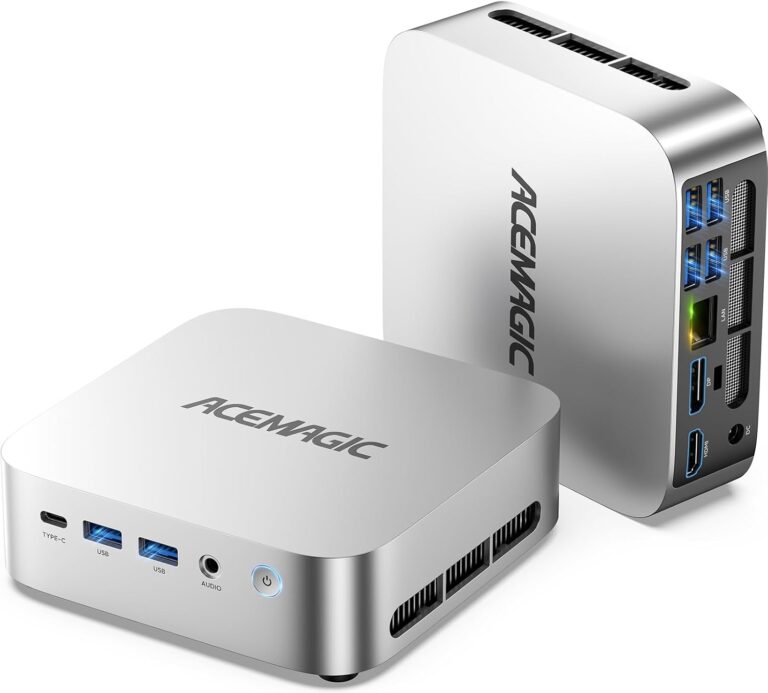
ACEMAGIC M1 (Ryzen 7 7735HS)
Eight Zen 3+ cores, Radeon 680M graphics and 24GB of LPDDR5 in a similar small case: more RAM and cores, older graphics architecture.
Check current price on Amazon- 24GB of memory
- 8 cores / 16 threads
- Free M.2 slot
- Older 6nm chip
- Memory also soldered
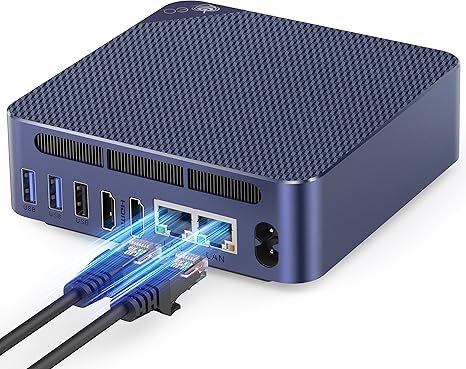
Beelink EQ14 (Intel N150)
An Intel N150 mini PC with dual 2.5GbE and a built-in power supply: enough for email, documents and video calls.
Check current price on Amazon- Dual 2.5GbE
- Internal power supply
- Upgradable SO-DIMM
- About a third of the K5's multi-core speed
- Two screens
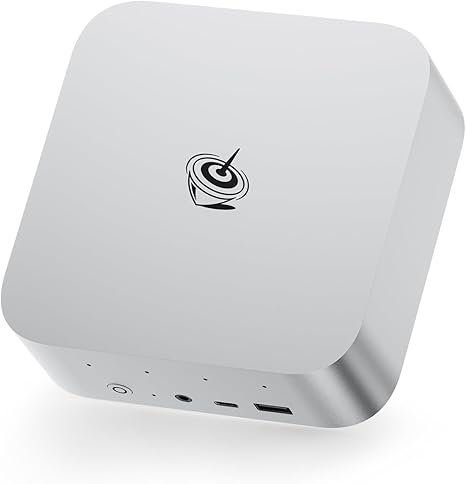
Beelink SER9 (Ryzen 7 H 255)
An 8-core Ryzen with Radeon 780M graphics, 32GB of LPDDR5X and USB4: noticeably faster in games than the Radeon 760M.
Check current price on AmazonRead our Beelink SER9 Pro (Ryzen 7 H 255) review
- Radeon 780M (12 CU)
- 32GB · USB4
- Costs more
More options by budget: best mini PCs under $500, best budget mini PCs, and today’s verified mini PC deals.
Pros and cons
AMD: more power and real graphics, but more heat and fewer published details. Intel: modern and frugal, but weak graphics and a slow bundled SSD. Both: soldered 16GB, no USB4.
K5 with Ryzen 5 PRO 7640HS
- 6 cores / 12 threads, about 74% faster in multi-core
- Radeon 760M: 1080p gaming at low settings
- Dual-channel LPDDR5
- Three 4K screens, Windows 11 Pro
- 16GB soldered, not upgradable
- 35–54W chip in a small box: more heat and noise under load
- No USB4 or OCuLink; USB-C can’t power it
- Few independent measurements yet
K5 with Intel Core 5 320
- Newest Intel platform, strong single-core speed
- About 4W idle (Core 3 version measured)
- 20Gbps USB-C with 100W power input
- 2.5GbE, Wi-Fi 6, six USB-A ports
- 16 TOPS NPU
- 6 threads only
- 2-core Xe graphics, not for gaming
- PCIe 3.0 SSD in a PCIe 4.0 x2 slot (about 1,780 MB/s)
- 16GB soldered · no USB4, no SD reader
Verdict
The AMD K5 is the better buy for most people at a similar price; the Intel K5 is a well-connected, efficient office PC that makes sense if you will never game and want low power.
ACEMAGIC’s naming does buyers no favors: two very different computers share the K5 badge. Read the processor name in the listing before anything else. With the Ryzen 5 PRO 7640HS, the K5 is a capable small desktop for the whole family, including light gaming. With the Core 5 320, it is a modern, quiet office box held back by its graphics and its storage choice. In both cases, 16GB of soldered memory is the ceiling, so be sure it is enough for you.
FAQ
What is the difference between the two ACEMAGIC K5 models?
They share a name and a 128 mm square form factor but use different platforms. One has Intel’s Core 5 320 (Wildcat Lake, 6 cores and 6 threads, about 25W) with 2-core Intel Xe graphics. The other has AMD’s Ryzen 5 PRO 7640HS (Zen 4, 6 cores and 12 threads, 35 to 54W class) with Radeon 760M graphics. Both ship with 16GB of soldered LPDDR5 and a 512GB SSD in the US configurations.
Which ACEMAGIC K5 is faster?
The AMD version in multi-core work and graphics. Notebookcheck’s average for the Ryzen 5 7640HS is 698 points in Cinebench 2024 multi-core, against 402 measured by TechRadar on the Intel K5, about 74% more. Single-core speed is close, with a slight edge for the Intel chip (110 vs 103).
Can the ACEMAGIC K5 play games?
The AMD version can run many games at 1080p low settings thanks to its 8-compute-unit Radeon 760M: Notebookcheck lists about 53 fps in F1 25 and 37 fps in Call of Duty Black Ops 6 on laptops with this GPU. The Intel version’s 2-core Xe graphics are meant for office work, video and very light games.
Can you upgrade the RAM in the ACEMAGIC K5?
No. Both versions use LPDDR5 memory soldered to the board, so the 16GB you buy is what you keep. Storage can be expanded: the Intel version has a second M.2 2280 slot (PCIe 4.0 x2), and ACEMAGIC lists up to 4TB of additional storage.
Is the ACEMAGIC K5 a Copilot+ PC?
No. Copilot+ PCs need an NPU of 40 TOPS or more. The Intel Core 5 320’s NPU is rated at about 16 TOPS (ACEMAGIC advertises up to 36 TOPS for the whole platform) and the Ryzen 5 7640HS’s NPU at 10 TOPS. Both can still accelerate some AI features and small local models.
Related
- ACEMAGIC M5 review
- ACEMAGIC K1 review
- Intel N150 vs N100 vs N97
- Mini PC buyer’s checklist
- Black Friday mini PC deals
Sources
- TechRadar, Acemagic K5 review (Sep 29, 2026): Core 5 320 specs, Cinebench 2024, Geekbench 6, 3DMark, storage, PCIe lanes
- ITPro, Acemagic Kron Mini K5 review (Oct 12, 2026): Geekbench 6, SSD speed, pros and cons
- CNX Software, ACEMAGIC Kron Mini K5 (Core 3 304) review, part 2 (Sep 6, 2026): power limits, power draw, temperatures, noise, network
- Retro Handhelds, AceMagic K5 review (Aug 2026, updated Sep 14): configuration, Geekbench AI, local LLM on the NPU
- Notebookcheck, Acemagic intros mini PC with Intel Wildcat Lake (Jun 18, 2026): ports, memory, M.2 slots
- Notebookcheck, AMD Ryzen 5 7640HS specifications and benchmarks (Cinebench 2024 and R23 averages, NPU)
- Notebookcheck, AMD Radeon 760M benchmarks (3DMark and game results)
- LaptopMedia, AMD Ryzen 5 PRO 7640HS specifications
- Starry Hope, ACEMAGIC K5 (Ryzen 5 PRO 7640HS) model page: memory, storage, ports, network, size
- Slickdeals, ACEMAGIC K5 Ryzen 5 PRO 7640HS (Oct 12, 2026): configuration and buyers’ notes on memory and ports
- ACEMAGIC K5 Amazon listings (Intel Core 5 320 and Ryzen 5 PRO 7640HS, 16GB, 512GB) and ACEMAGIC’s Japanese listing (24GB version); checked October 2026
- Microsoft, Copilot+ PCs (40+ TOPS NPU)