
GMKtec EVO-X3 Review: The Strix Halo Mini PC With OCuLink
GMKtec rebuilt its flagship Strix Halo mini PC from the ground up — a taller metal chassis, triple-fan cooling, a 140W performance mode, and something no other mini PC in this class has: an OCuLink port for connecting an external desktop GPU. At $3,799.99, it’s a premium alternative to the $2,999 BOSGAME M5. Here’s our full review.
Affiliate Disclosure: This article contains affiliate links. MiniPCDeals.net participates in the Amazon Associates program and manufacturer affiliate programs, and may earn a commission on qualifying purchases at no extra cost to you. Prices shown were checked on October 6, 2026 and can change quickly during the current memory shortage.
The GMKtec EVO-X3 is the most feature-complete Strix Halo mini PC you can buy — the OCuLink port alone makes it unique in this category. It pairs the same Ryzen AI Max+ 395 and 128GB LPDDR5X-8000 memory as the BOSGAME M5, but adds an external GPU connection, a redesigned triple-fan metal chassis, and a 140W peak performance mode. Independent testing by Level1Techs showed Qwen 3.6 generating at nearly 60 tokens per second on Windows, and SteamOS gaming at 1440p above 80 FPS in AAA titles. The trade-offs: $3,799.99 versus $2,999 for the M5, a much larger and heavier footprint (2.7 liters), and soldered memory with no upgrade path. If you want expansion flexibility and a premium build, the EVO-X3 justifies the premium. If you want the cheapest path to 128GB of local AI memory, the M5 is the better deal — see our full comparison.
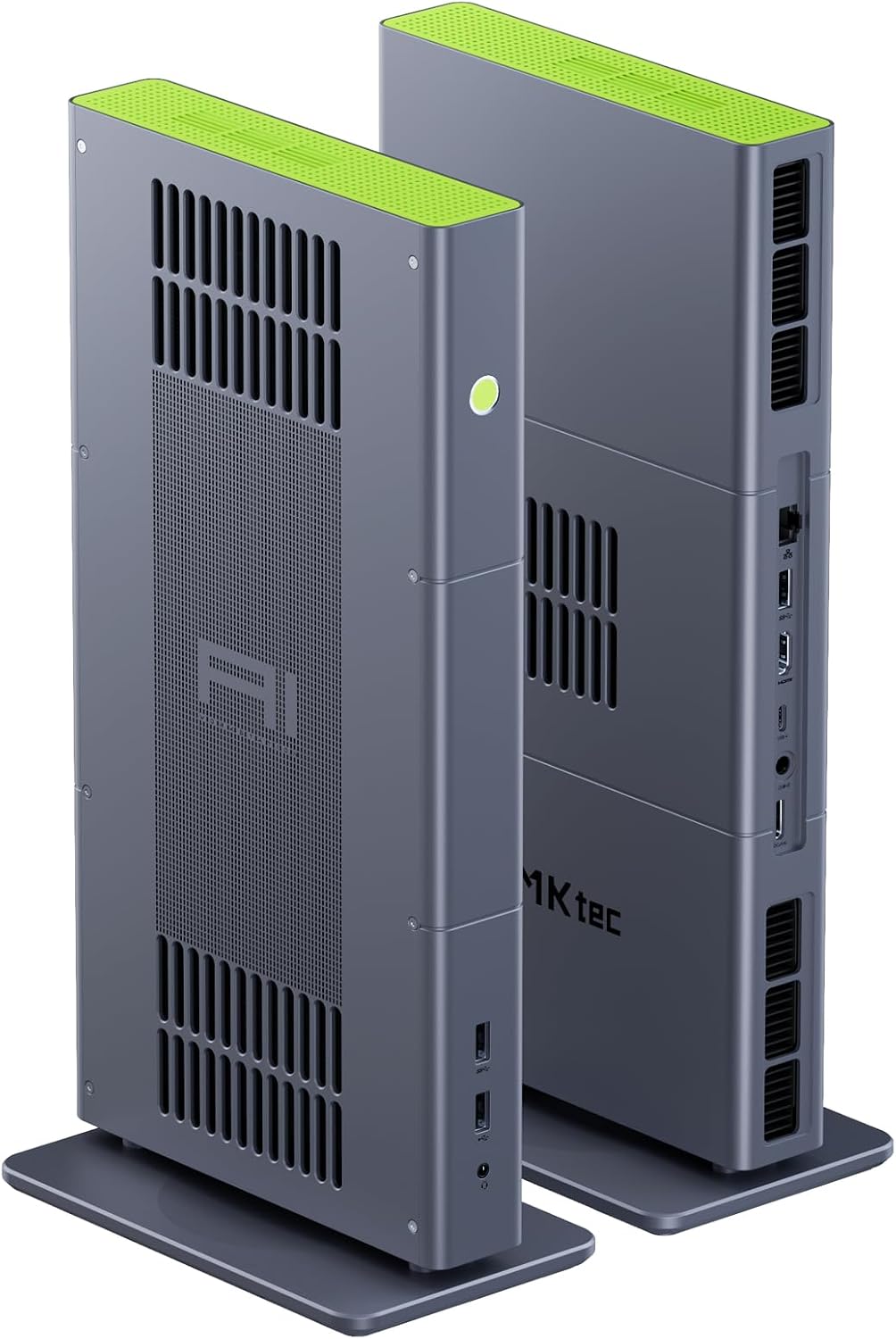
What Is the GMKtec EVO-X3?
The GMKtec EVO-X3 is the successor to the EVO-X2, rebuilt with a completely new metal chassis, triple-fan cooling, a 140W performance mode and one feature no other Strix Halo mini PC has: an OCuLink port for connecting an external desktop GPU.
GMKtec launched the EVO-X2 in early 2025 at around $1,999, and it quickly became a reference point for Strix Halo mini PCs. The EVO-X3 arrived in mid-2026 with the same Ryzen AI Max+ 395 APU — still the flagship Strix Halo chip — but wrapped in a substantially different machine. The old plastic-and-aluminum sandwich design is gone, replaced by a taller, tower-style metal chassis that Tom’s Hardware describes as “almost entirely metal” with a CNC-machined body and a textured green top cap.
The redesign is not purely cosmetic. The extra height accommodates larger fans, better exhaust pathways and more thermal headroom, which lets GMKtec push the APU to a 140W peak power mode — up from the EVO-X2’s more conservative limits. And the OCuLink port, which was absent on the EVO-X2, transforms the EVO-X3 from a fixed-configuration mini PC into a platform you can expand with a discrete GPU later.
What hasn’t changed: 128GB of onboard LPDDR5X-8000 unified memory, up to 96GB of which can be allocated as VRAM to the Radeon 8060S GPU. That’s the configuration that matters for local AI, and it’s identical to the BOSGAME M5 and the DGX Spark 128GB.
The EVO-X2 launched at around $1,999 for a 128GB configuration. The EVO-X3 launched at $3,600 for the same memory and storage — roughly double. The EVO-X3’s current price on GMKtec’s store is $3,799.99. Part of that is the redesigned chassis and OCuLink, but most of it is the global memory shortage. Tom’s Hardware put it bluntly: “the price has basically doubled as seemingly every electronics product with RAM and NAND chips inside has been affected by the ongoing component shortage.”
Full Specifications
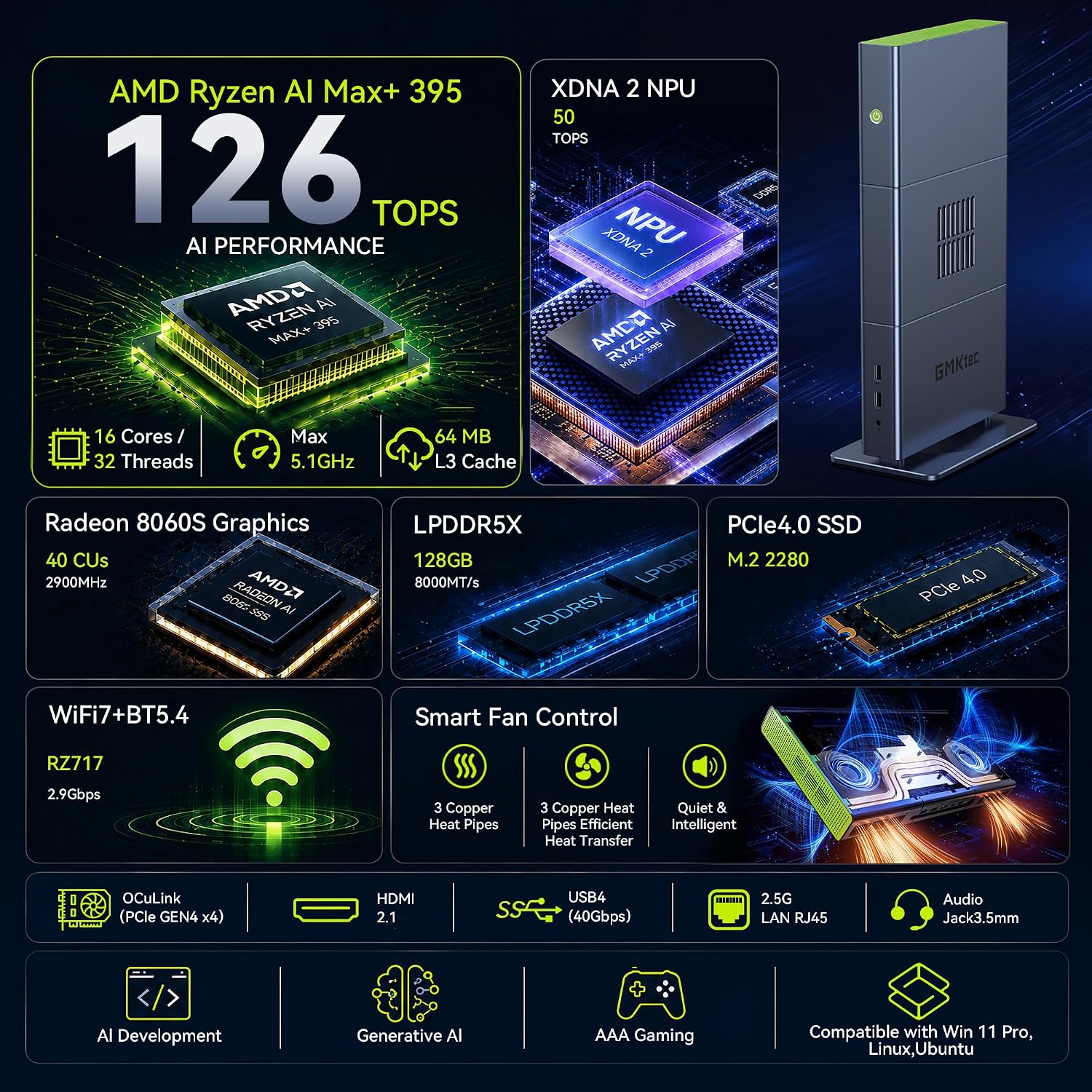
| Processor | AMD Ryzen AI Max+ 395 (Strix Halo) — 16 cores / 32 threads Zen 5, up to 5.1 GHz, TSMC 4nm, 64MB L3 cache |
|---|---|
| GPU | AMD Radeon 8060S — 40 RDNA 3.5 compute units, up to 2900 MHz |
| NPU | AMD XDNA 2 — 50 TOPS (126 TOPS total combined AI performance) |
| Memory | 128GB LPDDR5X-8000 unified, quad channel (soldered) |
| Memory allocation | Up to 96GB assignable to the Radeon 8060S GPU |
| Storage | 2TB or 4TB PCIe 4.0 NVMe SSD · dual M.2 slots · expandable to 16TB |
| Networking | Single 2.5GbE RJ45 (Realtek RTL8125BG) · Wi-Fi 7 · Bluetooth 5.4 |
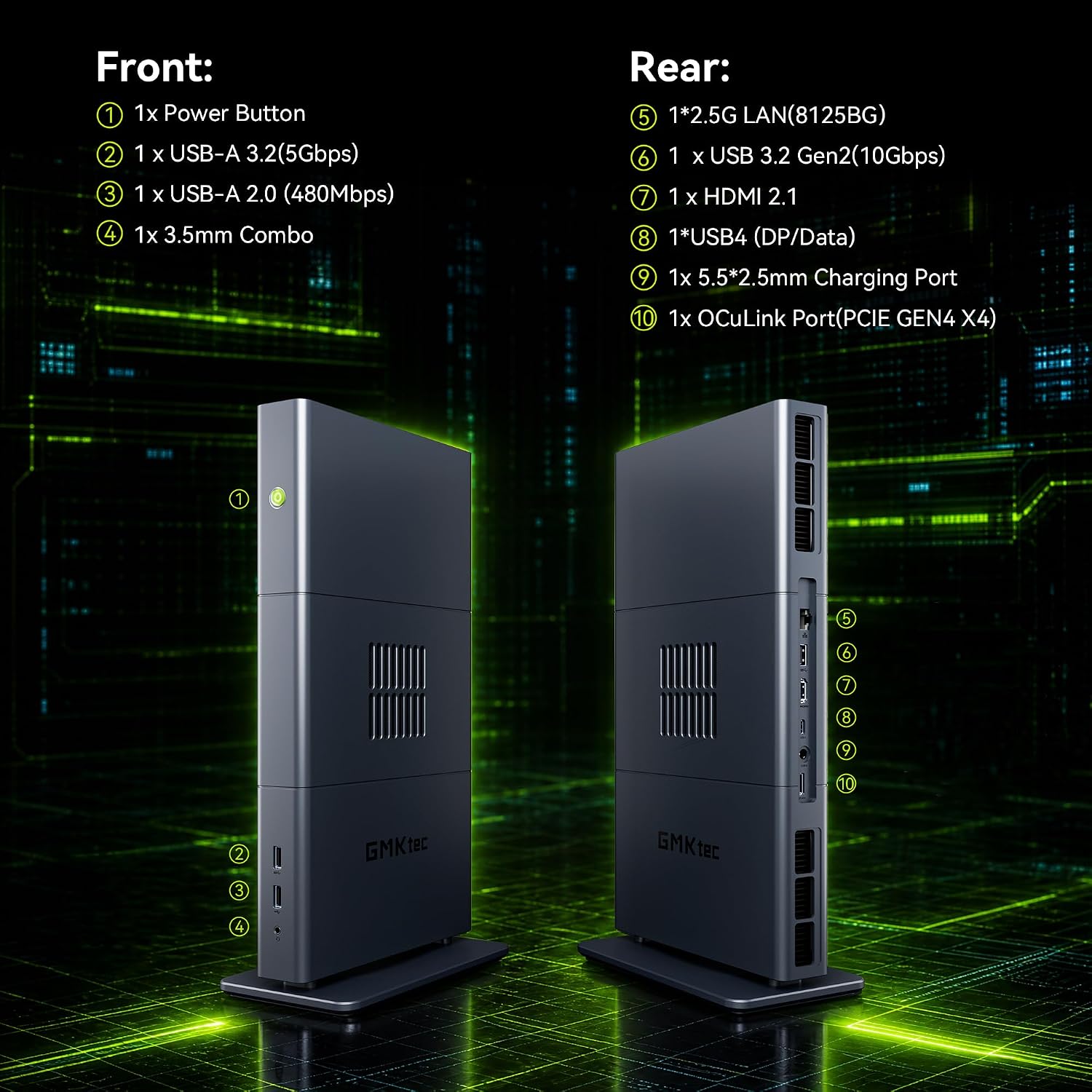
| Ports | 1× OCuLink (PCIe Gen4 x4) · 1× USB4 Type-C (100W PD) · USB 3.2 Gen 2 · HDMI 2.1 · 2.5GbE · 3.5mm audio |
| Power modes | Silent: 54W · Balanced: 85W · Performance: peak 140W |
| Cooling | Triple heat pipes · triple cooling fans |
| OS | Windows 11 Pro preinstalled (Linux and SteamOS compatible) |
| Chassis | Metal CNC body · ~2.7 liters · vertical tower design |
| Warranty | 1 year |
The OCuLink Advantage: What Makes the EVO-X3 Different
The EVO-X3 is the only Strix Halo mini PC with a built-in OCuLink port. That PCIe Gen4 x4 connection delivers far more bandwidth than USB4 for an external GPU — enough for Wendell of Level1Techs to plug an NVIDIA GPU and an AMD GPU into the same Strix Halo machine and run both simultaneously.
This is the EVO-X3’s defining feature. Every other mini PC in this class — the BOSGAME M5, the Minisforum MS-S1 Max, the Beelink GTR9 Pro — relies on USB4 or Thunderbolt for external expansion, which caps out at around 40 Gbps. OCuLink over PCIe Gen4 x4 offers 64 Gbps of raw bandwidth, and more importantly, it exposes the GPU over a PCIe link rather than a tunneled protocol. In practice, that means lower latency and better performance for eGPU workloads.
Level1Techs demonstrated something more interesting than a simple eGPU test. By combining the EVO-X3’s internal Radeon 8060S with an external NVIDIA card over OCuLink, they ran a hybrid configuration where the AMD GPU handled one part of the workload and the NVIDIA GPU handled another — in their case, generating about 87 tokens per second on the NVIDIA card while the AMD chip contributed about 24 tokens per second in parallel. The local model was even used to debug the cluster itself.
There’s a caveat worth stating clearly: PCIe Gen4 x4 will throttle modern high-end GPUs. An RTX 5090 running over OCuLink won’t deliver the same performance as it would in a full x16 slot. But for the kind of workloads this machine targets — accelerating prefill, adding CUDA capability for specific tools, or offloading a model that doesn’t fit in the 96GB VRAM allocation — OCuLink is a genuine and unique capability.
USB4 carries PCIe traffic through a tunnel, which adds overhead and latency. OCuLink is a direct PCIe connection — no tunnel, no protocol conversion. For storage and displays, the difference is negligible. For GPU workloads where latency and bandwidth matter, OCuLink is measurably better. The trade-off is cable length (OCuLink cables are short) and hot-plug support, which USB4 handles more gracefully.
GMKtec EVO-X3 — Ryzen AI Max+ 395 · 128GB · OCuLink · $3,799.99
Expand with an external desktop GPU over PCIe Gen4 x4. 140W performance mode, triple-fan cooling.
Local AI Performance: ~60 Tokens/Second on Qwen 3.6
With 128GB of LPDDR5X-8000 and up to 96GB allocatable to the GPU, the EVO-X3 runs 120B-class models locally. Level1Techs measured Qwen 3.6 at nearly 60 tokens per second on Windows using AMD’s Lemonade stack. A user report on GMKtec’s Japanese store shows Qwen 3.6 35B running at about 45 tokens per second in llama.cpp on Ubuntu.
The 140W performance mode deserves context. Wendell made the most useful observation in his review: for token generation, the CPU power limit doesn’t matter much — what matters is memory speed. The 140W mode helps with prefill and prompt processing, where compute matters more. For generation, you’re bound by the 8000 MT/s memory and the 256 GB/s memory bandwidth, not by how many watts the CPU is pulling. His AIDA64 run measured 118 GB/s of real-world memory bandwidth, which he compared to a quad-channel Threadripper system — impressive for a mini PC.
In his benchmark suite, Wendell also noted that the EVO-X3’s 16 Zen 5 cores “run circles around the 20 cores you get in the DGX Spark for CPU-type operations.” For mixed workloads that blend inference with traditional CPU compute, that’s a meaningful advantage.
- Qwen 3.6 (large model): ~60 tok/s on Windows with Lemonade stack (Level1Techs measurement)
- Qwen 3.6 35B: ~45 tok/s in llama.cpp on Ubuntu (user report, GMKtec JP store)
- 8B models: ~40 tok/s in hybrid mode (Level1Techs forum data)
- Time to first token: ~0.99 seconds on optimized setups, though an 18,000-token prompt took about 44 seconds to reach the first answer on a tuned 128GB Strix Halo configuration
The software situation is straightforward. Windows works, and AMD’s Lemonade stack provides a one-install path to the GPU and NPU. But Linux remains the better path for local AI — more control over memory allocation, and the BIOS now exposes SR-IOV, which lets you partition GPU resources for virtualization. GMKtec also ships its own Claw + Wrangler software for local AI agents, though most users in the local AI community will stick with Ollama or LM Studio.
Gaming and SteamOS: A Surprisingly Capable Machine
The Radeon 8060S is AMD’s fastest integrated GPU, and the EVO-X3’s 140W power budget lets it stretch further than most mini PCs. ETA Prime tested the machine with SteamOS and measured Cyberpunk 2077 at nearly 80 FPS at 1440p with high settings and FSR Quality. Horizon Zero Dawn Remastered and Spider-Man 2 both averaged over 80–85 FPS at 1440p.
SteamOS and the EVO-X3 are, in the words of Notebookcheck’s coverage, “a perfect combination.” Linux-based operating systems often extract better performance from AMD hardware than Windows does, and the EVO-X3’s triple-fan cooling keeps thermals under control during extended gaming sessions. Tom’s Hardware noted the machine stays “quiet under load” — the fans ramp up but remain unobtrusive, even at the 140W performance mode.
The gaming capability matters for a different reason: it makes the EVO-X3 a genuine all-in-one machine. You can run local LLM inference during the day, switch to a game in the evening, and do creative work in between — all on the same box. The DGX Spark can’t do that; it’s a Linux-only AI appliance with no gaming capability.
Wendell described the tower cooling as “basically inaudible” under 100W, but noted that the default BIOS fan curve only maxes out at 95°C — which he found too hot. He adjusted it to a more aggressive curve. At the 140W performance mode, the fans become more noticeable but remain within what most users would consider acceptable for a machine doing heavy work. The triple-fan design is a clear improvement over the EVO-X2’s dual-fan setup.
GMKtec EVO-X3 vs BOSGAME M5 vs DGX Spark 128GB
| GMKtec EVO-X3 | BOSGAME M5 | DGX Spark 128GB | |
|---|---|---|---|
| Price | $3,799 | $2,999 | $6,950 |
| Unified memory | 128GB LPDDR5X-8000 | 128GB LPDDR5X-8000 | 128GB LPDDR5X |
| Price per GB | ~$30/GB | ~$23/GB | ~$54/GB |
| OCuLink | Yes (PCIe Gen4 x4) | No | No |
| Peak power | 140W | ~120W | 170W typical |
| SD card reader | No | Yes (full-size) | No |
| Networking | 1× 2.5GbE | 1× 2.5GbE | ConnectX-7 + 10GbE |
| AI stack | ROCm / llama.cpp / Ollama | ROCm / llama.cpp / Ollama | CUDA + FP4 |
| Clustering | No | No | ConnectX-7 200Gb/s |
| OS | Windows / Linux / SteamOS | Windows / Linux | DGX OS (Linux only) |
| Gaming | Yes — 1440p AAA above 80 FPS | Yes — 1080p RTX 4070-class | No |
| Chassis | Metal CNC · triple-fan | Metal · dual-fan | Compact · passive |
| Warranty | 1 year | 1 year | Standard NVIDIA |
The EVO-X3 occupies a distinct position. It’s $800 more than the BOSGAME M5 but adds OCuLink, a larger metal chassis, a 140W performance mode and triple-fan cooling. Against the DGX Spark 128GB, it’s $3,150 cheaper and far more versatile as a general-purpose machine — but it lacks CUDA, FP4 acceleration and ConnectX-7 clustering.
If you’re building a local AI setup and trying to decide between Strix Halo and the Spark, our full comparison of the DGX Spark 64GB, 128GB and Strix Halo covers the decision tree in detail. And if you’re new to the platform, our Strix Halo explainer covers the architecture and what makes it suitable for local AI.
Verdict: Should You Buy the GMKtec EVO-X3?
Buy the EVO-X3 if you want OCuLink, a premium metal chassis, and the flexibility to add an external GPU later. Buy the BOSGAME M5 instead if you want the cheapest path to 128GB of unified memory and don’t need eGPU expansion. Skip both if your workflow depends on CUDA or you need NVIDIA’s clustering capability.
Buy the GMKtec EVO-X3 ($3,799) if…
- You want the OCuLink port — it’s the only Strix Halo mini PC with one, and it opens the door to external GPU acceleration later
- You want a premium metal chassis with triple-fan cooling and a quiet experience under heavy AI loads
- You want to run SteamOS for gaming alongside your AI workloads — the EVO-X3 is exceptionally well-suited to it
- You value build quality and thermals enough to pay $800 more than the M5
Buy the BOSGAME M5 ($2,999) instead if…
- Price per GB is your priority — the M5 is the cheapest 128GB Strix Halo mini PC on the market
- You want a built-in SD card reader — the M5 has one, the EVO-X3 doesn’t
- You don’t need OCuLink and prefer a smaller, lighter machine
Consider the DGX Spark 128GB ($6,950) if…
- Your workflow is CUDA-native — professional ML development or NVIDIA AI Enterprise
- You need FP4 acceleration or ConnectX-7 clustering
- Budget is not the primary constraint
GMKtec’s store currently shows a banner reading “Price increase coming soon — order now to lock in the current price!” That’s consistent with everything we’ve seen across the Strix Halo market in 2026. The EVO-X3’s price has already risen from its $3,600 launch to $3,799.99. If you’re planning a purchase, the trend line is still up — see our Best Mini PCs for Local AI in 2026 guide for current picks across all price tiers.
GMKtec EVO-X3 — OCuLink, 128GB, 140W performance mode
The most feature-complete Strix Halo mini PC. Add an external GPU when you need more power.
Frequently Asked Questions
Sources & Notes
Specifications sourced from GMKtec’s official product page. Independent performance figures from Tom’s Hardware (Evo-X3 review, September 2026), Level1Techs (Wendell’s review and benchmarks, August 2026), Notebookcheck (SteamOS gaming tests, August 2026) and VettedConsumer (Level1Techs analysis, August 2026). Pricing checked on GMKtec’s store and Amazon on October 6, 2026 — prices are volatile during the current memory shortage and shown as a snapshot. User token-rate figures (Qwen 3.6 35B at ~45 tok/s) are from a customer report on GMKtec’s Japanese store and have not been independently verified under identical conditions. Vendor claims (LM Studio 2.2× faster than RTX 4090) are GMKtec marketing figures and should be treated as such.