
BOSGAME M5 Review: The Cheapest 128GB Strix Halo Mini PC in 2026
The BOSGAME M5 packs AMD’s Ryzen AI Max+ 395, 128GB of LPDDR5X unified memory and a Radeon 8060S into a $2,999 box — at a time when every other 128GB Strix Halo mini PC costs $3,500 or more. We tested it, benchmarked it against the DGX Spark and the MS-S1 Max, and here’s what we found.
Affiliate Disclosure: This article contains affiliate links. MiniPCDeals.net participates in the Amazon Associates program and manufacturer affiliate programs, and may earn a commission on qualifying purchases at no extra cost to you. Prices shown were checked on October 6, 2026 and can change quickly during the current memory shortage.
The BOSGAME M5 is the value leader of the Strix Halo generation: 128GB of unified memory, a 16-core Ryzen AI Max+ 395, Radeon 8060S graphics and 126 TOPS of AI performance for $2,999 — roughly $500 to $800 less than the GMKtec EVO-X2 or Minisforum MS-S1 Max at equivalent specs. It runs 120B-class language models locally at around 40 tokens per second, handles 1080p gaming without a discrete GPU, and is the only mini PC in its class with a built-in full-size SD card reader. The trade-offs: soldered memory, a single 2.5GbE port (no 10GbE), and fan noise that becomes noticeable under sustained loads. If you want maximum local AI capability per dollar in October 2026, this is the box to beat — see how it stacks up in our DGX Spark 64GB vs 128GB vs Strix Halo comparison.
What Is the BOSGAME M5?
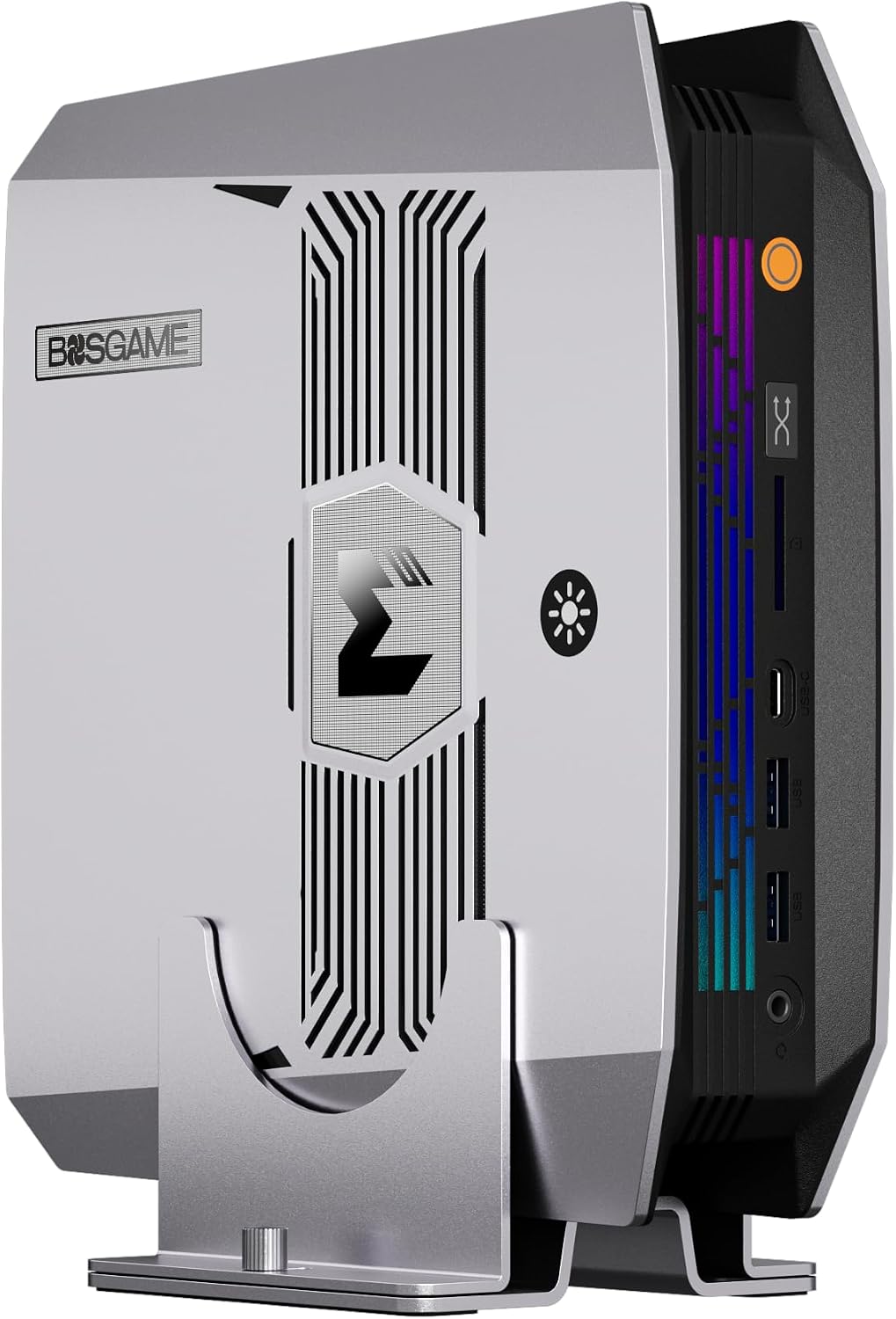
The BOSGAME M5 is a Strix Halo mini PC built around AMD’s Ryzen AI Max+ 395 APU, with 128GB of LPDDR5X unified memory and a Radeon 8060S integrated GPU. Its claim to fame is price: at $2,999 it undercuts every other 128GB Strix Halo box on the market by $500 or more.
BOSGAME is not a name most buyers will recognize alongside GMKtec or Minisforum, but the M5 competes directly with those machines on hardware. Inside is the same Ryzen AI Max+ 395 platform that powers the Strix Halo generation: 16 Zen 5 cores, 32 threads, a 40-CU Radeon 8060S GPU and a dedicated XDNA 2 NPU rated at 50 TOPS. The chassis is a compact metal box with intake vents on top, a vertical stand, and an RGB light strip controllable through a touch-sensitive button.
What makes the M5 interesting in October 2026 is timing. The global memory shortage has pushed 128GB Strix Halo mini PCs from around $2,000 a year ago to $3,500–$4,350 today. The M5 at $2,999 is the exception — the cheapest way to get 128GB of unified memory in a general-purpose mini PC. For context, NVIDIA’s DGX Spark 128GB now costs $6,950, and even the new 64GB model starts at $4,999. That price gap is the entire argument for the M5.
If you’re not familiar with AMD’s Ryzen AI Max platform, read our full Strix Halo explainer. The short version: it’s the first consumer APU that combines a high-performance CPU, a capable iGPU, and up to 128GB of unified LPDDR5X memory in a single package — which is exactly what local LLM inference needs.
Full Specifications
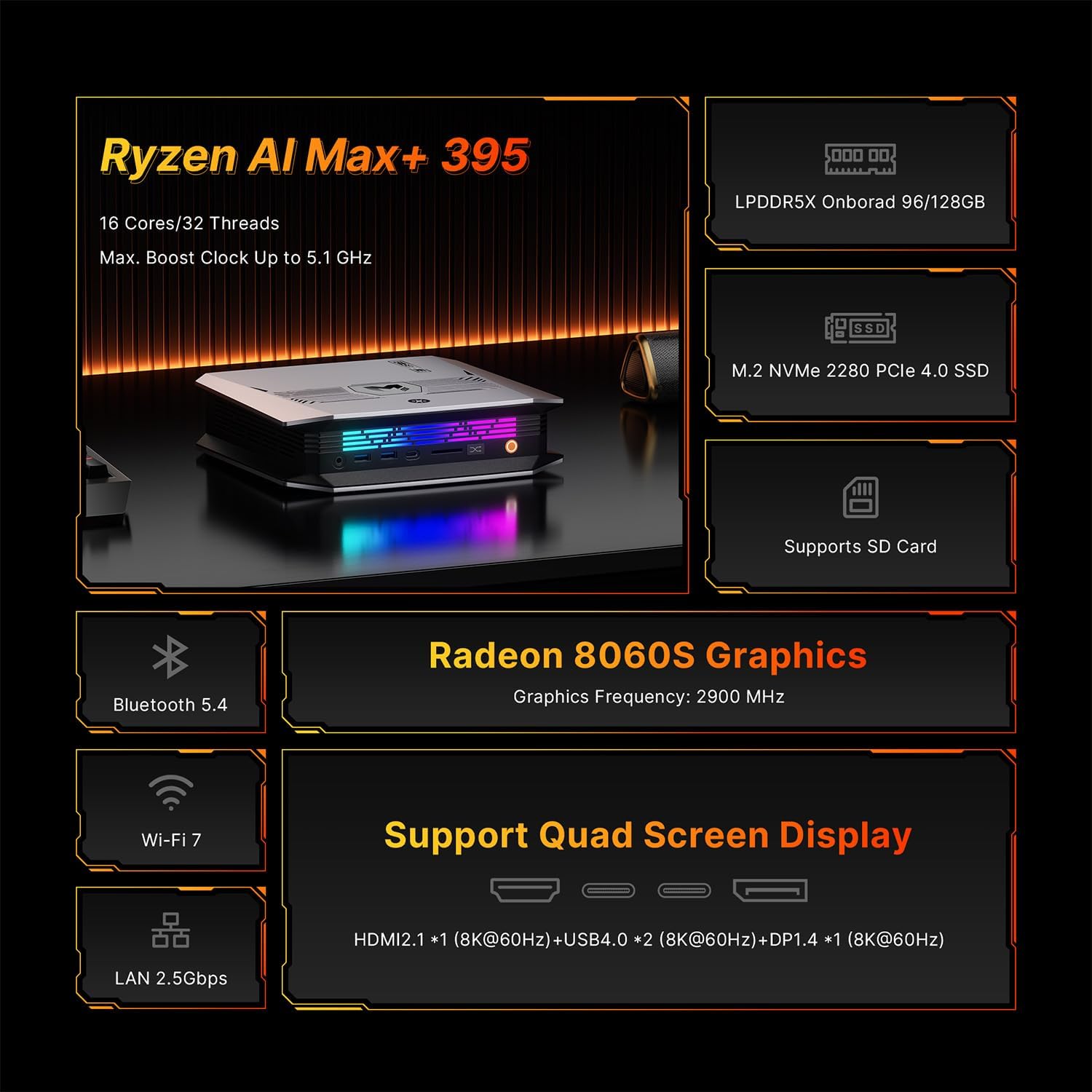
| Processor | AMD Ryzen AI Max+ 395 (Strix Halo) — 16 cores / 32 threads Zen 5, up to 5.1 GHz |
|---|---|
| GPU | AMD Radeon 8060S — 40 RDNA 3.5 compute units, up to 2900 MHz, 32MB MALL cache |
| NPU | AMD XDNA 2 — 50 TOPS (126 TOPS total combined compute) |
| Memory | 128GB LPDDR5X unified — 8000 MT/s, quad channel (soldered) |
| Memory allocation | Up to 96GB can be assigned to the Radeon 8060S GPU |
| Storage | 2TB PCIe 4.0 NVMe SSD (YMTC or Kingston depending on batch) + 1 free M.2 PCIe 4.0 slot |
| Networking | Single 2.5GbE RJ45 · Wi-Fi 7 (MediaTek RZ717) · Bluetooth 5.3 |
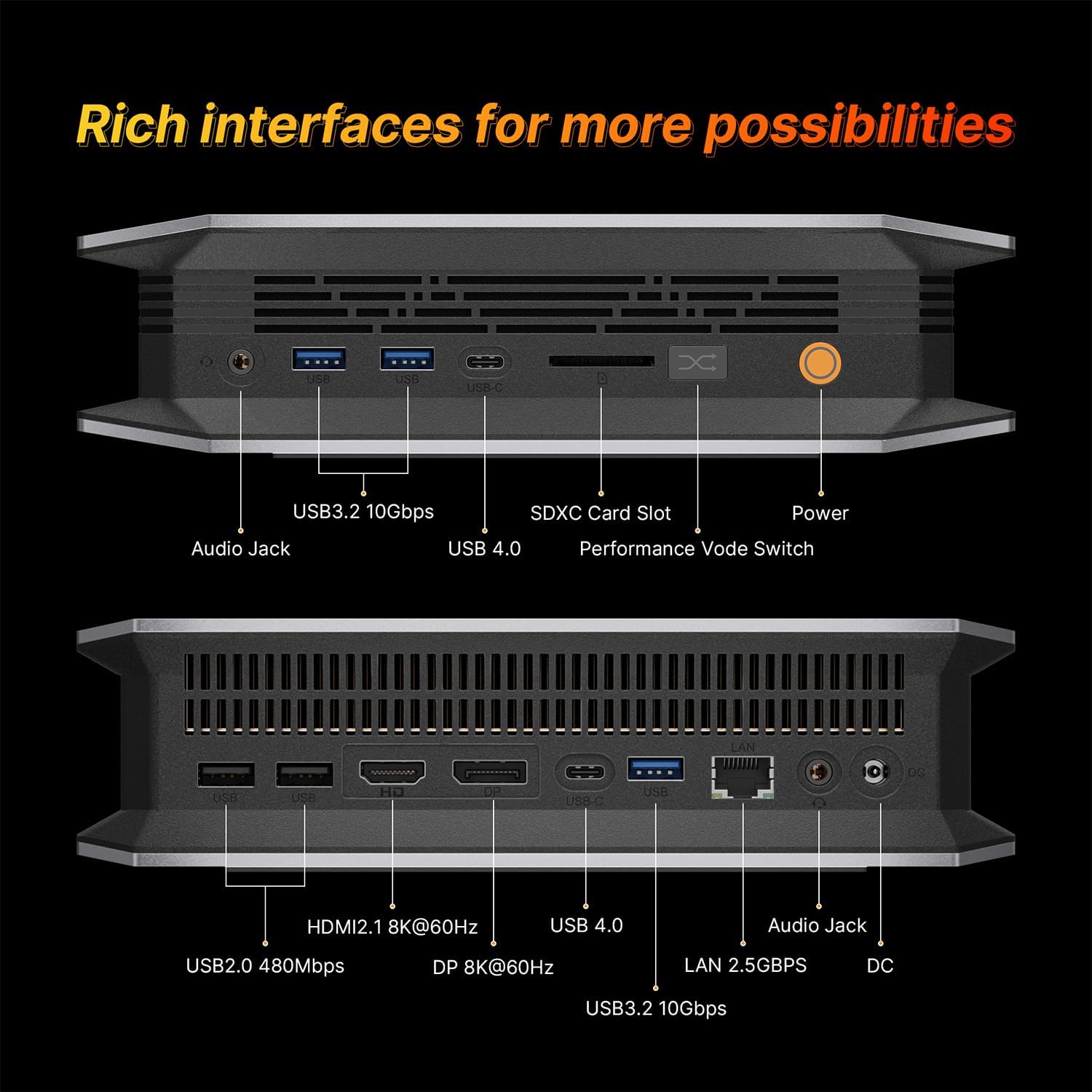
| Ports | 2× USB4 Type-C (40 Gbps, DisplayPort Alt Mode) · 4× USB 3.2 Gen 2 (10 Gbps) · 2× USB 2.0 · HDMI 2.1 (8K) · DisplayPort 1.4 · full-size SD card reader · 2× 3.5mm audio |
| OS | Windows 11 Pro preinstalled (Linux compatible) |
| Power | 240W adapter · three configurable power profiles |
| Chassis | Metal body with vertical stand · top intake vents |
| Warranty | 1 year (short for this price class) |
Two details stand out from the spec sheet. First, the SD card reader — the M5 is the only Strix Halo mini PC with one built in. If you shoot photos or video, this is a genuine convenience that the GMKtec EVO-X2, Beelink GTR9 Pro and Minisforum MS-S1 Max all lack. Second, the single 2.5GbE port, which is the M5’s biggest connectivity compromise. The MS-S1 Max offers dual 10GbE, and the EVO-X2 has two 2.5GbE ports. For homelab users or anyone planning network-attached storage alongside their AI workloads, that’s worth factoring in.
Local AI Performance: What 128GB Actually Gets You
With 128GB of unified memory and up to 96GB allocatable to the GPU, the M5 runs 120B-class language models locally at around 40 tokens per second. It’s not the fastest Strix Halo box — sustained performance trails the Minisforum MS-S1 Max — but at $2,999 it delivers the same memory capacity for roughly half the price of a DGX Spark 128GB.
Here’s what the numbers look like in practice:
- 120B-class models (gpt-oss-120b, Llama 3.3 70B): around 40 tokens/second in llama.cpp or Ollama, with the standard RADV open-source drivers on Linux. The community benchmark cited most often is gpt-oss-120b at ~40 tok/s with a 30,000-token context.
- 30B-class models (Qwen3 27B, Mistral Small): comfortably interactive, well above the threshold for real-time conversation and agent workflows.
- Prefill performance: this is where the M5 trails NVIDIA hardware. A head-to-head with the ASUS GX10 (GB10-based) showed first-token times of 26.8 seconds on the M5 versus 8.7 seconds on the GX10. For long-prompt workloads, that gap matters. For token generation, the two are much closer.
BOSGAME’s marketing claims Llama 3 runs 2.2× faster than on an RTX 4090 in LM Studio. That figure needs context: it’s a vendor claim, and the comparison is against a consumer GPU limited to 24GB of VRAM, which cannot hold a large model in memory at all. The honest framing is that the M5’s advantage is capacity, not raw speed. It can run models the RTX 4090 physically cannot load.
The M5 ships with Windows 11 Pro, which is fine for gaming and office work, but Linux is the better path for local AI — you get more control over CPU/GPU memory allocation. Ollama, LM Studio and llama.cpp all work on both. If you’re new to this, our Ollama setup guide and LM Studio guide will get you running in under an hour.
BOSGAME M5 — Ryzen AI Max+ 395 · 128GB LPDDR5X · 2TB · $2,999
Runs 120B-class models at ~40 tok/s. The lowest price per GB of unified memory in the current market.
Gaming and Creative Work: The Radeon 8060S Surprise
The Radeon 8060S is not a token integrated GPU — it delivers 1080p gaming performance comparable to an entry-level discrete card, trading blows with an RTX 4070 Laptop GPU. Benchmarks put the M5 essentially level with the GMKtec EVO-X2 and slightly behind the Minisforum MS-S1 Max in sustained loads.
For a $2,999 machine that’s primarily a local AI workstation, the gaming capability is a bonus that changes how you think about the purchase. If you’re choosing between a DGX Spark (Linux-only AI appliance, no gaming) and the M5, the M5 gives you a fully functional Windows PC between AI sessions.
Creative workloads benefit too. The 128GB memory pool is generous for Photoshop, video editing, 3D rendering and virtualization — PhotoShop and content-creation performance scored well in independent testing. The two M.2 slots mean you can add a second SSD without opening the whole chassis: one screw holds the access hatch.
Under sustained heavy loads, the M5’s dual-fan cooling becomes audible. It’s not disruptive at idle or during typical AI inference, but extended CPU or GPU stress tests will produce noticeable noise. The EVO-X2 uses a triple-fan plus vapor-chamber design that handles sustained loads more quietly. If silence matters, that’s a point in GMKtec’s favor.
BOSGAME M5 vs DGX Spark vs MS-S1 Max
| BOSGAME M5 | DGX Spark 128GB | Minisforum MS-S1 Max | |
|---|---|---|---|
| Price | $2,999 | $6,950 | $3,799 |
| Unified memory | 128GB LPDDR5X | 128GB LPDDR5X | 128GB LPDDR5X |
| Price per GB | ~$23/GB | ~$54/GB | ~$30/GB |
| AI stack | ROCm / llama.cpp / Ollama | CUDA + FP4 | ROCm / llama.cpp |
| Clustering | No | ConnectX-7 200Gb/s | Dual 10GbE |
| Networking | Single 2.5GbE | ConnectX-7 + 10GbE | Dual 10GbE |
| SD card reader | Yes (full-size) | No | No |
| OS | Windows 11 Pro / Linux | DGX OS (Linux only) | Windows / Linux |
| Gaming | Yes — 1080p, RTX 4070 Laptop-class | No | Yes |
| Warranty | 1 year | Standard NVIDIA | Standard Minisforum |
The comparison tells a clear story. The M5 wins on price and price-per-GB, and it’s the only machine here that’s a fully general-purpose PC with an SD card reader. The MS-S1 Max wins on networking (dual 10GbE), cooling and build quality, for $800 more. The DGX Spark wins on software ecosystem — CUDA, FP4 acceleration and ConnectX-7 clustering — for more than double the price.
If you’re weighing Strix Halo against the Spark more broadly, our full DGX Spark 64GB vs 128GB vs Strix Halo comparison covers the full decision tree, including the clustering math and the software trade-offs.
Verdict: Should You Buy the BOSGAME M5?
Buy the BOSGAME M5 if you want 128GB of unified memory for local AI at the lowest possible price, and you don’t need 10GbE networking or CUDA. Skip it if your workflow depends on NVIDIA’s software stack, if you need dual 10GbE for a homelab setup, or if you want the quietest possible machine under sustained load.
Buy the BOSGAME M5 ($2,999) if…
- You want to run 120B-class open models locally — gpt-oss-120b, Llama 3.3 70B and similar, at around 40 tok/s
- Price per GB of unified memory is your priority — at ~$23/GB, nothing else in this class comes close
- You want a machine that also works as a Windows PC for gaming, creative work and office tasks between AI sessions
- You need a built-in SD card reader — the M5 is the only option in this category
- You’re comfortable with ROCm, llama.cpp or Ollama rather than CUDA
Consider the Minisforum MS-S1 Max ($3,799) if…
- You need dual 10GbE networking for a homelab or NAS setup
- You want better sustained cooling and lower fan noise under heavy loads
- You’re willing to pay $800 more for a better-built machine with more connectivity
Consider the DGX Spark 128GB ($6,950) if…
- Your workflow is CUDA-native — professional ML development or NVIDIA AI Enterprise
- You need FP4 acceleration or ConnectX-7 clustering
- Budget is not the primary constraint
The M5’s $2,999 price is remarkable partly because it hasn’t risen as sharply as its competitors. The GMKtec EVO-X2 and Beelink GTR9 Pro have both seen substantial price increases, and the DGX Spark 128GB jumped 75% in a year. If you’re planning a local AI purchase, the trend line is still up. See our Best Mini PCs for Local AI in 2026 guide for current picks across all price tiers.
BOSGAME M5 — 128GB unified memory at $2,999
The cheapest 128GB Strix Halo mini PC on the market. In stock on Amazon.
Frequently Asked Questions
Sources & Notes
Specifications sourced from BOSGAME’s official product page and Amazon listing. Independent performance figures from TechPowerUp (Bosgame M5 review, October 2026), Wccftech (August 2026), ServeTheHome (August 2026), Guru3D (August 2025) and Hardware Busters (September 2026). Pricing checked on Amazon and BOSGAME’s store on October 6, 2026 — prices are volatile during the current memory shortage and shown as a snapshot. Vendor performance claims (2.2× faster than RTX 4090 in LM Studio) are BOSGAME marketing figures and have not been independently verified under identical conditions. Community token-rate figures (gpt-oss-120b at ~40 tok/s) are from user reports on NotebookCHECK and Reddit’s r/LocalLLaMA.